Category Archives: civil rights

See Marilyn Humphries photos from the June 14 Con Con

You can see Marilyn’s photographs from the June 14 Constituttional Convention by going to these links:

 http://www.mhimages.net/070614cc1/index.htm  http://www.mhimages.net/070614cc2/index.htm http://www.mhimages.net/070614cc3/index.htm

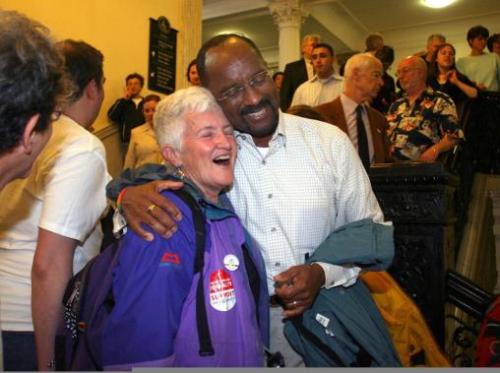
These images show the power of democracy. With thousands of LGBT people and their allies watching, the Massachusetts legislature voted 151-45 to kill a constitutional amendment banning same-sex marriage.

Celebrating at the State House

Pat Gozemba & David Wilson

Pat Gozemba (left) of Salem was embraced by David Wilson, one of the original plaintiffs in the landmark same-sex marriage lawsuit. The pair celebrated after the vote outside the House chamber. (Boston Globe photo John Tlumacki)

June 14, 2007 will become a historic day in the annals of equality in this state and in this country. Gov. Deval Patrick said it right. “This is not just a great day for marriage equality–it’s a great day for equality.”

It was a thrill to celebrate with Dave Wilson and with the thousands of marriage equality supporters who came to the State House for this nerve-wracking but historic day.

All of us in the LGBT community and our allies who have spent countless hours and days working on this issue feel grateful to the 151 legislators (75% +1) who voted for equality. New profiles in courage emerged!

Check our blog later for more photos by Marilyn Humphries.

Recording Equality, Brian Jewell interviews Marilyn Humphries, Bay Windows, 5.17.07

Since the 1980s, photographer Marilyn Humphries has been documenting progressive movements. Her camera has brought Bay Windows readers to the front lines of the fight for LGBT equality from the early days of the AIDS epidemic to the advent of civil marriage rights. The photos of the latter — her award-winning photographs of the struggle for marriage equality in Massachusetts — have been collected in the recently published book Courting Equality from Beacon Press. With a history of the movement written by Patricia A. Gozemba and Karen Kahn to accompany Humphries’s historic photos, the book is a moving and invaluable time capsule. Humphries found some time between the book launch and photo assignments to talk with Bay Windows about sharing her eyes with the world. An excerpt appears below. For the full interview.Q: You must be very busy these days.
A: It’s really nice to have a few moments to just think about things instead of the next task. I feel like ever since November of 2003 I’ve been on the hamster wheel from hell, as so many of us have been. And adding the book on to that was like, how much more can you take?

Q: Covering the Constitutional Conventions must be a real marathon.
A: Yeah, those are pretty grueling. You get there at 7 and they get out at midnight. That’s pretty tough.

Q: How do you get through it?
A: Understanding the importance of what’s happening. And there’s [Bay Windows associate editor] Laura Kiritsy in the background saying, ‘Get up there and get that photo!’

Q: You’ve had a unique view of the marriage fight.
A: It’s an amazing viewpoint. Particularly at the State House. It’s like watching a documentary unfold. Everybody else was on the other side of these roped off areas, singing and jostling for position. It was very intense to watch, and very moving. It’s such a privilege and an honor to be in that position and try to capture it.

Q: Is it hard to cover, when you have a personal stake?
A: Yes, that’s something that’s always been difficult. You try to shoot it like you would anything, getting the visual element that tells the story. I hope I’ve been fairly objective about it, but that’s an elusive thing. In a lot of situations there are some really hard things said. Sometimes directed at me personally, because some of the anti-marriage equality people knew I represented Bay Windows. The closest I came to ever becoming deranged was snapping the guy with the giant sign about sodomy. It’s one of the photos in the book. I was trying to get a picture of him  and he came over and started shoving the sign in my face! I said some things to him I probably shouldn’t have. He was baiting me and I shouldn’t have responded. I think that’s the only time I ever did. You know, you’re exhausted, your nerves are frayed … it’s hard.

Q: What about happier events, like the first marriage licenses? I remember I was at Cambridge City Hall when they had the first registrants for gay marriage licenses, and I was just overwhelmed. I couldn’t imagine having to work, too.
A: That was really hard. First, there was so much going on all over. I got into the chambers and got stuck there. It was too hard to get out. I could hear the crowd outside, and I knew there  was stuff happening all over City Hall. It was such chaos, but it was joyous chaos. When I finally got out, it was unbelievably moving to see all those folks. That was intense and wonderful and I’m so glad I was there.

Q: How did the book come about?
A: I was visiting Pat and Karen, who are dear friends of mine. I was showing some of the photos to them and Evelyn C. White of the San Francisco Chronicle, and she said you have to do a book. I said, I’m not capable of doing that. I don’t have the time, and I don’t know how to do it. And Pat and Karen looked at each other and said, then we’ll do it with you. This never would have happened without them. Trying to make a living as a photographer is so time consuming. Anyway, they led the way. 

Q: Is there another boo coming?
A: I don’t think so! But I am working on a project with the Holter Museum of Art in Montana. They’re doing a show about response to the right wing in general. They asked me to submit a few things to represent the gay and lesbian community. How can you represent that in one or two photos? So the curator suggested I put together a Powerpoint slideshow, which let me use about 400 photos. The curator told me that when she watched it, she wept. It made me realize again what an extraordinary state we live in. So I’m hoping this show will travel around the country.

Q: And hopefully the book will have a ripple effect across the country.
A: That’s what it’s all about for us, that people who have not really looked closely at this issue will look at the book and get accurate information on what went on, and see all those joyous faces. I hope the book will change some people’s perceptions.

Q: How did you get started?
A: In college I majored in history and philosophy. Not very practical, but it instilled a sense of historical perspective. When I moved to Massachusetts, I got involved in some of the early feminist and gay and lesbian efforts. Pat was very involved in those, and she knew how to do photography. She taught me how to use a camera, so we’ve come full circle. My first taste of what it could be like was the protests at Seabrook. I went up there with my little camera and took pictures. And Sojourner — this is full circle again, because Karen would come to edit that paper — published some of them. I thought, ‘Wow, I can take pictures and people will publish them?’ That was all it took. And I love being up close to things out of the ordinary. People are so impassioned, so full of a sense of mission and often in the face of scary stuff. It’s so moving to me, whether it’s an anti-war protest or the trans people lobbying or the fight for marriage equality. I love trying to capture that. Those people are so heroic to me. We’re lucky to have a lot of those people in our community,

Q: And lucky to have someone to record them.
A: It’s a delightful thing to record.
 

Martina Brendel interviews CE authors for Salem News, 6.5.07

It’s hard to deny someone their happiness.That’s the thinking behind Pat Gozemba and Karen Kahn’s new book “Courting Equality,” which uses the photos of Beverly photographer Marilyn Humphries to tell the history of same-sex marriage in Massachusetts. The Salem couple will be at Cornerstone Books this Thursday to sign copies.

“The photos really inspired us to write the book,” Kahn said. “We hadn’t been thinking about writing a book about this. When we saw the photos, we realized what an incredible documentation of a historic moment it was.”

Besides the familiar images of activists demonstrating at the Statehouse, the glossy coffee-table book also features dozens of portraits of blushing brides and grooms engaged in all the rites of marriage – from cutting the cake to catching the bouquet to dancing with family and friends.

“I hope that people will see the great joy and security that has become part of the lives of same-sex couples because of the benefit of marriage being granted in Massachusetts,” Gozemba said. “And I hope it will open people’s minds to see the inequities and prejudices that have kept us from this benefit for so many years.”

Gozemba, a retired Salem State College English professor, and Kahn, an editor, have lived together for 15 years. It wasn’t until they began working on “Courting Equality” in March 2005, however, that these Willows residents decided to get married.

“Until we started working on the book, we weren’t convinced that marriage was really important for us,” Gozemba said. “Afterward, we realized how many protections that are really critical to people’s lives are afforded through marriage. Working on the book and doing research convinced us we should get married.”

The couple were married at Cambridge City Hall on Sept. 1, 2005, though they took out their marriage application at Salem City Hall.

Working together on the book was “really fun,” Kahn said. The couple collaborated once before on Gozemba’s 2001 book “Pockets of Hope,” a collection of inspiring stories about community teaching that Kahn edited. This is the first time they have co-authored a book.

“We had a wonderful time writing the book together,” Kahn said. “We really respect each other’s opinions. Pat worked as a professor, I was an editor for many years. It’s easy for us to work with each other.”

They never pictured themselves writing a coffee-table book, but the photos speak for themselves, they said.

“We did it because we feel that the photos are so impressive that even if a person just looks through and reads the photo captions, they will get the message of the book,” Gozemba said. “We felt the photos were that powerful.”

On equality anniversary, marriage rights threatened

CE authors were happy to discover that their op-ed on marriage equality ran in The Columbian, a local newspaper in the not-so-blue region of southern Washington State. Here’s the text:

 Three years ago on May 17, lesbian and gay residents of Massachusetts filed for the
first legal marriage licenses in the United States.
    With marriage equality, nearly 9,000 Massachusetts same-sex couples have wed in civil or religious ceremonies since 2004. Hundreds of thousands of people from across the nation have witnessed our weddings.
    Many of us married because we wanted to symbolize our love and commitment, to protect our families in times of crisis, to access benefits — such as family health insurance, hospital visitation rights and joint property rights. We also married because we wanted to give our children more security and to proclaim to our
communities our status as families.
    Same-sex marriage is a success in Massachusetts. The sky has not fallen. Massachusetts continues to lead the country with one of the lowest divorce rates of any state — 2.5 percent — according to Census data.
    And nearly 800 religious leaders in the state have signed a declaration supporting same-sex marriage.
    Moreover, no clergy members have been forced to marry any couples whom they did not choose to recognize as worthy of marriage according to the dictates of their religion.
    Yet, a well-funded right-wing religious coalition persists in trying to undo our civil rights by bringing a constitutional amendment banning same-sex marriage to the ballot in 2008. Other such amendments have passed in 26 states.
    The group offers only religious arguments for ending same-sex civil marriage and it insists that the “people deserve to vote.”
    But since when in our democracy does the majority vote on the civil rights of a minority? Would anyone suggest that people vote on whether interracial marriage should be banned once again?
    On May 17, 1954, the U.S. Supreme Court ruled that “separate but equal” was unconstitutional, setting into motion a movement to ensure full equality for African-Americans.
    Fifty years later on May 17, 2004, same-sex couples filed for the first legal marriage licenses in this country.
    The symmetry of these anniversaries is not lost on the lesbian and gay community.    Same-sex couples should not tolerate “separate but equal” civil unions. Second-class citizenship is neither fair nor right. It certainly is not what we value as American citizens.

Pat & Karen on NECN with Jim Braude

Laura Kiritsy notes ACLU’s commitment to marriage equality, Bay Windows, 5.10.07

ACLUM’s commitment to Courting Equality is but one example of the pivotal behind-the-scenes role the organization has played in the struggle to achieve and preserve marriage equality in Massachusetts. It’s a commitment that stretches back to the 1990s, when ACLUM lobbyist Norma Shapiro represented the organization in what was known as the “Group of Groups,” an informal coalition of LGBT and allied organizations that was planning, strategizing and negotiating to advance the cause of legal recognition for same-sex couples in the state legislature. Initially the Groups’ focus was domestic partnership legislation; in the early 2000s it shifted to civil unions. Along the way, they also fended off attempts to pass DOMA legislation. Most notably, they helped coordinate the strategy in which legislators, led by then-Senate President Tom Birmingham, killed the anti-gay constitutional amendment via parliamentary maneuvering at a 2002 constitutional convention. More