See Marilyn Humphries photos from the June 14 Con Con

You can see Marilyn’s photographs from the June 14 Constituttional Convention by going to these links:

 http://www.mhimages.net/070614cc1/index.htm  http://www.mhimages.net/070614cc2/index.htm http://www.mhimages.net/070614cc3/index.htm

These images show the power of democracy. With thousands of LGBT people and their allies watching, the Massachusetts legislature voted 151-45 to kill a constitutional amendment banning same-sex marriage.

Celebrating at the State House

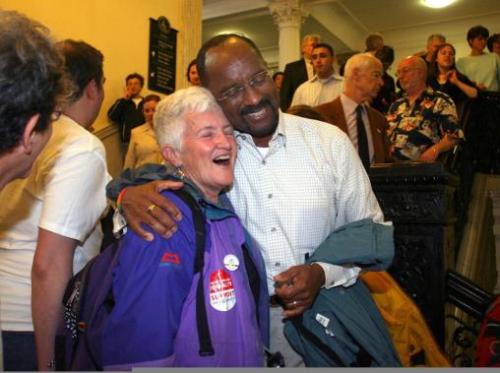
Pat Gozemba & David Wilson

Pat Gozemba (left) of Salem was embraced by David Wilson, one of the original plaintiffs in the landmark same-sex marriage lawsuit. The pair celebrated after the vote outside the House chamber. (Boston Globe photo John Tlumacki)

June 14, 2007 will become a historic day in the annals of equality in this state and in this country. Gov. Deval Patrick said it right. “This is not just a great day for marriage equality–it’s a great day for equality.”

It was a thrill to celebrate with Dave Wilson and with the thousands of marriage equality supporters who came to the State House for this nerve-wracking but historic day.

All of us in the LGBT community and our allies who have spent countless hours and days working on this issue feel grateful to the 151 legislators (75% +1) who voted for equality. New profiles in courage emerged!

Check our blog later for more photos by Marilyn Humphries.

Recording Equality, Brian Jewell interviews Marilyn Humphries, Bay Windows, 5.17.07

Since the 1980s, photographer Marilyn Humphries has been documenting progressive movements. Her camera has brought Bay Windows readers to the front lines of the fight for LGBT equality from the early days of the AIDS epidemic to the advent of civil marriage rights. The photos of the latter — her award-winning photographs of the struggle for marriage equality in Massachusetts — have been collected in the recently published book Courting Equality from Beacon Press. With a history of the movement written by Patricia A. Gozemba and Karen Kahn to accompany Humphries’s historic photos, the book is a moving and invaluable time capsule. Humphries found some time between the book launch and photo assignments to talk with Bay Windows about sharing her eyes with the world. An excerpt appears below. For the full interview.Q: You must be very busy these days.
A: It’s really nice to have a few moments to just think about things instead of the next task. I feel like ever since November of 2003 I’ve been on the hamster wheel from hell, as so many of us have been. And adding the book on to that was like, how much more can you take?

Q: Covering the Constitutional Conventions must be a real marathon.
A: Yeah, those are pretty grueling. You get there at 7 and they get out at midnight. That’s pretty tough.

Q: How do you get through it?
A: Understanding the importance of what’s happening. And there’s [Bay Windows associate editor] Laura Kiritsy in the background saying, ‘Get up there and get that photo!’

Q: You’ve had a unique view of the marriage fight.
A: It’s an amazing viewpoint. Particularly at the State House. It’s like watching a documentary unfold. Everybody else was on the other side of these roped off areas, singing and jostling for position. It was very intense to watch, and very moving. It’s such a privilege and an honor to be in that position and try to capture it.

Q: Is it hard to cover, when you have a personal stake?
A: Yes, that’s something that’s always been difficult. You try to shoot it like you would anything, getting the visual element that tells the story. I hope I’ve been fairly objective about it, but that’s an elusive thing. In a lot of situations there are some really hard things said. Sometimes directed at me personally, because some of the anti-marriage equality people knew I represented Bay Windows. The closest I came to ever becoming deranged was snapping the guy with the giant sign about sodomy. It’s one of the photos in the book. I was trying to get a picture of him  and he came over and started shoving the sign in my face! I said some things to him I probably shouldn’t have. He was baiting me and I shouldn’t have responded. I think that’s the only time I ever did. You know, you’re exhausted, your nerves are frayed … it’s hard.

Q: What about happier events, like the first marriage licenses? I remember I was at Cambridge City Hall when they had the first registrants for gay marriage licenses, and I was just overwhelmed. I couldn’t imagine having to work, too.
A: That was really hard. First, there was so much going on all over. I got into the chambers and got stuck there. It was too hard to get out. I could hear the crowd outside, and I knew there  was stuff happening all over City Hall. It was such chaos, but it was joyous chaos. When I finally got out, it was unbelievably moving to see all those folks. That was intense and wonderful and I’m so glad I was there.

Q: How did the book come about?
A: I was visiting Pat and Karen, who are dear friends of mine. I was showing some of the photos to them and Evelyn C. White of the San Francisco Chronicle, and she said you have to do a book. I said, I’m not capable of doing that. I don’t have the time, and I don’t know how to do it. And Pat and Karen looked at each other and said, then we’ll do it with you. This never would have happened without them. Trying to make a living as a photographer is so time consuming. Anyway, they led the way. 

Q: Is there another boo coming?
A: I don’t think so! But I am working on a project with the Holter Museum of Art in Montana. They’re doing a show about response to the right wing in general. They asked me to submit a few things to represent the gay and lesbian community. How can you represent that in one or two photos? So the curator suggested I put together a Powerpoint slideshow, which let me use about 400 photos. The curator told me that when she watched it, she wept. It made me realize again what an extraordinary state we live in. So I’m hoping this show will travel around the country.

Q: And hopefully the book will have a ripple effect across the country.
A: That’s what it’s all about for us, that people who have not really looked closely at this issue will look at the book and get accurate information on what went on, and see all those joyous faces. I hope the book will change some people’s perceptions.

Q: How did you get started?
A: In college I majored in history and philosophy. Not very practical, but it instilled a sense of historical perspective. When I moved to Massachusetts, I got involved in some of the early feminist and gay and lesbian efforts. Pat was very involved in those, and she knew how to do photography. She taught me how to use a camera, so we’ve come full circle. My first taste of what it could be like was the protests at Seabrook. I went up there with my little camera and took pictures. And Sojourner — this is full circle again, because Karen would come to edit that paper — published some of them. I thought, ‘Wow, I can take pictures and people will publish them?’ That was all it took. And I love being up close to things out of the ordinary. People are so impassioned, so full of a sense of mission and often in the face of scary stuff. It’s so moving to me, whether it’s an anti-war protest or the trans people lobbying or the fight for marriage equality. I love trying to capture that. Those people are so heroic to me. We’re lucky to have a lot of those people in our community,

Q: And lucky to have someone to record them.
A: It’s a delightful thing to record.
 

Martina Brendel interviews CE authors for Salem News, 6.5.07

It’s hard to deny someone their happiness.That’s the thinking behind Pat Gozemba and Karen Kahn’s new book “Courting Equality,” which uses the photos of Beverly photographer Marilyn Humphries to tell the history of same-sex marriage in Massachusetts. The Salem couple will be at Cornerstone Books this Thursday to sign copies.

“The photos really inspired us to write the book,” Kahn said. “We hadn’t been thinking about writing a book about this. When we saw the photos, we realized what an incredible documentation of a historic moment it was.”

Besides the familiar images of activists demonstrating at the Statehouse, the glossy coffee-table book also features dozens of portraits of blushing brides and grooms engaged in all the rites of marriage – from cutting the cake to catching the bouquet to dancing with family and friends.

“I hope that people will see the great joy and security that has become part of the lives of same-sex couples because of the benefit of marriage being granted in Massachusetts,” Gozemba said. “And I hope it will open people’s minds to see the inequities and prejudices that have kept us from this benefit for so many years.”

Gozemba, a retired Salem State College English professor, and Kahn, an editor, have lived together for 15 years. It wasn’t until they began working on “Courting Equality” in March 2005, however, that these Willows residents decided to get married.

“Until we started working on the book, we weren’t convinced that marriage was really important for us,” Gozemba said. “Afterward, we realized how many protections that are really critical to people’s lives are afforded through marriage. Working on the book and doing research convinced us we should get married.”

The couple were married at Cambridge City Hall on Sept. 1, 2005, though they took out their marriage application at Salem City Hall.

Working together on the book was “really fun,” Kahn said. The couple collaborated once before on Gozemba’s 2001 book “Pockets of Hope,” a collection of inspiring stories about community teaching that Kahn edited. This is the first time they have co-authored a book.

“We had a wonderful time writing the book together,” Kahn said. “We really respect each other’s opinions. Pat worked as a professor, I was an editor for many years. It’s easy for us to work with each other.”

They never pictured themselves writing a coffee-table book, but the photos speak for themselves, they said.

“We did it because we feel that the photos are so impressive that even if a person just looks through and reads the photo captions, they will get the message of the book,” Gozemba said. “We felt the photos were that powerful.”

Susan Jacobs recommends Courting Equality in the Jewish Journal

Three local women have collaborated to create a comprehensive book that traces the gay marriage movement in Massachusetts. “Courting Equality: A Documentary History of America’s First Legal Same-Sex Marriages” was released on the third anniversary of marriage equality in Massachusetts.

Written by Salem activists Pat Gozemba and Karen Kahn, with pictures by Beverly-based photojournalist Marilyn Humphries, the work follows the gay struggle for social justice in the Bay State.

The candid photographs by Humphries, whose freelance work has appeared in the New York Times, Bay Windows and the Boston Phoenix, among other publications, form the backbone of the book. The eloquent prose provides context and background. Presented together, the pictures and text paint a passionate portrait of a milestone event that changed the course of history in Massachusetts.

The glossy, large format book aptly captures the steely determination and ultimate jubilation experienced by those most intimately involved in the battle to bring equal civil rights to same-sex couples.

“Courting Equality” focuses primarily on the seven same-sex couples, known as the Goodridge plaintiffs, who got the ball rolling in April 2001, by suing the Department of Public Health for the right to marry. The writers interviewed all the couples, as well as other key players in the battle. Humphries, who spent several years on the front line with her camera, captured the passion and outrage of supporters on both sides of the contentious issue.

While “Courting Equality” has a more limited audience than a pictorial retrospective on the work of Picasso, which your average heterosexual household would probably rather have on the coffee table anyway, that shouldn’t diminish the value of this important book. Gozemba, Kahn and Humphries have created an historically accurate work that should be included in every library.

For those who may not remember, the Massachusetts Supreme Judicial Court granted equal marriage benefits to same-sex couples in a landmark decision November 18, 2003. With the ruling, the Bay State became the only one in the union to recognize and legally sanction the right of homosexuals to marry. City and town officials began issuing marriage licenses to same-sex couples May 17, 2004.

Kahn and Gozemba personally hold one of the 9,700 same-sex marriage licenses that have been issued in Massachusetts since the law went into effect three years ago. The interfaith couple wed in September 2005 at Cambridge City Hall.

Kahn and Gozemba were not surprised that Massachusetts was the first state to legally sanctify same-sex marriage. “Massachusetts has strong civil rights traditions. It was the first place to abolish slavery,” pointed out Kahn.

“Marriage was not a top priority for us,” admitted the 51-year-old Kahn, who works as communications director for a non-profit health care organization. “But seeing the reaction of the Right Wing, the Catholic Church, and our Mormon governor made me aware that we suffered from an oppression that we weren’t even aware of.”

“Marriage is the primary institution of social order in our country. It’s the way all benefits, such as pensions and social security, flow to people. We must have access to this,” said Gozemba, who is 62.
Gozemba, a former professor of English and Women’s Studies, likens the struggle to the one fought by blacks decades ago. “We do not want to drink from the ‘gay’ water fountain. Separate but equal is not good enough,” she said.

To change the law on a federal level, she believes individual states must be targeted. “African Americans worked state-by-state for integration of the schools. By the time the issue got to federal court, it was already law in many areas. We must follow the same strategy,” Gozemba said.

Gozemba thinks progress is being made. “Ten states currently recognize gay relationships; seven of them offer marriage or civil union by one name or another. But we have a mishmash of recognitions — marriage, civil unions, domestic partnerships. It’s uneven and unclear from state to state,” she said.

Kahn and Gozemba point out that concerns that gay marriage might destroy the ‘traditional family unit’ have proven unfounded. “No one’s heterosexual marriage has been damaged as a result of the ruling, and Massachusetts continues to have the lowest divorce rate in the United States,” Gozemba said.

Maggie Smith-Dalton profiles authors in Salem Gazette, 6.1.07

Hitch your wagon to a star.” — Ralph Waldo Emerson, “Society and Solitude”
It’s the faces which impact you most directly.

The book’s text is by turns informative, thought-provoking and challenging. The narrative is well-crafted. The political machinations and the constitutional arguments engage your intellect and the human interest stories kindle that little hearth in your heart. The book itself is pure aesthetic pleasure — handsomely produced, cleanly designed, glossy and oversized, lavishly illustrated. It even smells good.

But as you leaf through, you look at the photos, at the beaming faces of the newly-married couples, and marvel at their diversity: old, young, middle-aged. You gaze at their children — that tiny girl dressed in frothy lace nervously ready for the wedding march; a laughing child dancing up a storm at the wedding reception; the two shyly-smiling boys draped over parental shoulders. Children, of every description, framed in flowers, encircled by a hug.

“I’m glowing from the inside. Happy is an understatement,” says one bride, married to her partner of 18 years in an early-morning May ceremony.

Many readers will realize, with a start, that as they read they are smiling too, are actually beaming ear-to-ear, echoing the absolute undiluted joy radiating from those wedding-day faces. That the reader is gazing at pictures of women coupled with women and men hand-in-hand with men may not cross his or her mind until later.

Perhaps that’s where “Courting Equality: A Documentary History of America’s First Legal Same-Sex Marriages” a new book about the historical and history-making journey to secure the rights of marriage and equal treatment under the law for same-sex couples, most achieves its goal.

According to its authors, their purpose in writing the book can be described in its most basic sense as underscoring the democratic birthrights of all citizens and urging the necessity of advocacy and action to secure those rights.

“I’m passionate about democracy,” Patricia Gozemba tells the Gazette as she and co-author Karen Kahn sit chatting recently in a sunny, breezy corner of the Front Street Coffeehouse, “as a strategy for bringing equity to all people.”

 “Democracy” is a word used frequently in conversation with the couple, who live in Salem, and never is it uttered casually.

“Courting Equality” also features the work of the couple’s longtime friend and colleague, photographer Marilyn Humphries; the book is lavishly illustrated with photos which place the viewer right smack dab in the “action” of the story.

Her photos serve to highlight the diverse personalities, ages and situations of the many people, both gay and straight, who participated in the struggle to achieve what advocates see as an affirmation of basic, constitutionally-provided civil rights.

Kahn and Gozemba met in 1987, through Humphries, when Marilyn was Pat’s roommate and worked as a photographer for “Sojourner: The Women’s Forum” (at the time a widely-read activist, feminist newspaper). Kahn edited the paper at the time, and for the following 10 years.

A casual friendship developed between the two women; but, they say, they really “got together” at a 1990 Women’s Studies Conference in Ohio — “on Independence Day,” they laugh. They have been together for 17 years and married in 2005.

Through their eyes

Both Gozemba, who is a retired Salem State College English and women’s studies professor, and Kahn, who is now the communications director for the Paraprofessional Healthcare Institute (www.paraprofessional.org) have long histories separately and together of involvement in social and political causes.

They recounted childhood memories of making speeches “standing for democracy,” holding neighborhood carnivals to raise money for people with multiple sclerosis, and keen awareness of social justice issues and civil rights issues from early ages. Their advocacy work currently includes environmental issues; health care policy, research, and analysis; and, of course, the rights of gays and lesbians in civic life.

“I’m very much influenced by Emerson and Thoreau,” says Gozemba, “I always felt that what I was doing [as a teacher] was to empower students to ask questions … question authority.” She sees her current work as a natural outgrowth of her lifelong calling as an innovative teacher, and continues to be a driving force in educational efforts such as The History Project, a documentary effort built around the history of Boston’s gay and lesbian community (www.historyproject.org).

The well-constructed text of “Courting Equality” includes engaging anecdotes about individual plaintiffs and participants in the fight to obtain rights for same-sex couples; you come to understand the emotional impact of the struggle through their eyes.

Yet the book is also intellectually engaging, and provides much documentary and historical detail, albeit presented in an accessible fashion. One chapter provides a succinct historical account of the legal and societal journey gay and lesbian activists have been on since the early 1970s. Other chapters put the reader “inside” the legislative discussions, argument, and strategies as the fight to ensure marriage equality wound its way through successive Massachusetts constitutional conventions.

And the goal was reached when, in light of affirmation that “the Massachusetts Constitution affirms the dignity and equality of all individuals. It forbids the creation of second-class citizens,” on May 17, 2004, the state began to issue marriage licenses to same-sex couples.

Coincidentally, May 17, 2004 was also the 50th anniversary of the Brown vs. Board of Education decision, another landmark date in civil rights history.

Social responsibility

Although the culminating result of these struggles has been positive for the marriage equality cause, with Massachusetts’s highest court affirming the constitutional right for same-sex couples to marry — fueling the momentum towards the same result in at least 10 other states of the union —worries remain for these couples.

A proposed constitutional amendment to ban same-sex marriages, and a push to put such an amendment on the 2008 ballot as a strategy to reopen the fight, is creating feverish lobbying efforts on both sides of the issue. In early May, a Constitutional Convention was held by the House and Senate, but they avoided taking a vote on the amendment.

The next session is slated for June 14, and Senate President Therese Murray has said the plan is to put the measure before the Legislature for an up-or-down vote.

“When we leave this church, there are forces of anger, ignorance, and hate that seek to tear asunder the bonds of this marriage,” state Rep. Mike Festa is quoted saying at the wedding of state Sen. Jarrett Barrios and Doug Hattaway. “But … the inexorable march toward full equality cannot be stopped.”

“They [the right wing] want Massachusetts to become the center of the battle,” says Kahn. “But the reality is that we have this enormous positive momentum.”

Gozemba adds, “We have in New England a visionary culture … and a social responsibility.” She feels the most important message of their work is to bring home the message that active, ordinary citizens are the indispensable components of a working democracy.

“Our book crystallizes a lot of the actions, small and large, that people took, the strategies … We are showing what people can do if they flex their muscles in the democratic system” the educator says.

The May-morning sunlight streams over both of them, as they sit at a little round cafe table amid the bustle of a now late-morning coffeehouse crowd — many of whom greet Gozemba and Kahn as they pass.

Two faces alight with passion, determination, and yes — with devotion — to each other, and to their many causes. Causes which could all, perhaps, be summed up as one cause … hitching the practical wagons of democracy to the stars of idealism and living as full citizens of a cherished democracy.

Book of Love

Barbara Taormina interviewed Courting Equality authors Gozemba, Kahn, and Humphries. Her feature appeared in North Shore Sunday on May 27, 2007:

When Pat Gozemba and Karen Kahn first got together 17 years ago, they weren’t really thinking about marriage. Part of being a same-sex couple meant breaking free from typical roles and expectations.

“Marriage really wasn’t my issue,” says Gozemba, who adds that tradition was something gay and lesbian couples were moving away from, not pursuing.

And 17 years ago, marriage — and all the benefits and rights attached — wasn’t an option; it wasn’t within the realm of possibilities.

But all of that changed in November 2003, when the Massachusetts Supreme Judicial Court ruled the state could no longer deny the protections, benefits and obligations of civil marriage to same-sex couples. This was, after all, Massachusetts, and the commonwealth or at least the SJC didn’t want to create a group of second-class citizens.

Gozemba and Kahn rode the roller coaster ride to that landmark decision, and along the way their feelings about marriage changed. Same-sex marriage was no longer a personal decision or statement. It was a civil rights issue, and one of the most important civil rights issues of the opening years of the 21st century.

And when you’re cruising along an important shift in history, you want to do something; you want to play a part. So Gozemba, a former professor of English and women’s studies at Salem State, and Kahn, a former editor of Sojourner, a Boston-based feminist newspaper, did one of the things they do best — they wrote.

They joined forces with Marilyn Humphries, a photojournalist from Beverly, and together the three women told the story of the battle over same-sex marriage in a new book, “Courting Equality: A Documentary History of America’s First Legal Same-Sex Marriages.”

Kahn is the first to admit that when she agreed to do the book, she didn’t quite think it through.

“We knew we should help, we knew we should do this,” she says. “But we didn’t realize it would take up two years of our lives.”

Writing the history of people who are dead and buried is hard enough, but writing history as it unfolds around you can be excruciating. Things change, circumstances evolve and in the case of the same-sex marriage battle in Massachusetts, legislative votes keep changing the landscape.

For Gozemba and Kahn that meant dropping everything for last-minute updates and giving up vacations to do final re-writes. And although the story isn’t finished just yet, the book is.

 But for anyone hoping to understand the importance of the next chapter — the upcoming Constitutional Convention in June when state lawmakers will vote again on whether or not to put question of same-sex marriage on the 2008 ballot — “Courting Equality” is a must-read. It’s a history filled with big ideas and small touches that offers us all what we need to know and understand about why same-sex marriage is important to everyone.

Every picture tells a story

Like Gozemba and Kahn, Marilyn Humphries wasn’t all that determined to walk down any aisles.

“Marriage didn’t seem to matter that much,” she says. “Now in retrospect, I see that getting into certain institutions elevates your rights across the board.”

That’s not an easy concept to capture on film, but Humphries manages. “Courting Equality” is filled with images, personal and public, that show the passion that has surrounded the same-sex marriage debate. There are plenty of shots of speeches and protests at the State House that capture the emotion on both sides. And Humphries is especially kind to many of the state legislators who risked careers with their votes.

In fact, she’s even kind to the opponents who showed up to protest equal marriage.

“There were far uglier pictures of them that she could have chosen for the book,” laughs Gozemba.

Humphries’ photos offers a detailed historical record that takes us back in time to earlier fights for gay rights, through the Goodridge decision which legalized same-sex marriage and right into the center of the heated debates that played out on Beacon Hill.

 But it’s the same sharp eye for detail that makes “Courting Equality” fun just to flip through. There are slews of pictures of celebrations, wedding photos with cakes and flowers and portraits of parents and kids that show what same-sex marriage means to countless families throughout the state.

Gozemba and Kahn follow pretty much the same recipe for success with the text. If you need or want a historical overview of the gay rights moments in America, “Courting Equality” has that. The authors take a lot of complex legal and political information and make it accessible.

But like Humphries, Gozemba and Kahn go a step further and make “Courting Equality” a story about individual couples and families.

“We wanted to tell this history in a narrative fashion,” says Gozemba. “People relate to stories.”

And those stories resonate. When they explain the battle the gay community waged over the right to care for foster children, they do it through the experience of Donald Babets and David Jean, who were asked by the Department of Social Services to care for two young brothers. Babets and Jean opened their home and their hearts to those kids, only to have the state overrule DSS and move them to another home.

And when Gozemba and Kahn describe the scene in front of Cambridge City Hall on May 16, 2004, the night before the first same-sex marriage licenses were issued, they take you there in the company of Ralph Hodgdon and Paul McMahon, who had been together for 49 years and really weren’t looking to get married. Hodgdon and McMahon showed up for the party but apparently before they knew it, they were in line for a license.

Most of us have followed the equal marriage debate through television broadcasts and newspaper accounts, and we’ve gotten the sound bites and — if we’ve paid close enough attention — we’ve picked up the general gist of the various votes and political maneuvers. But most of us were not at the rallies or in the corridors of the State House, and we really have no idea the tensions, the fears and the excitement that surrounded all of it.

But Gozemba and Kahn were there, and in “Courting Equality” they paint us all sorts of pictures of people praying and singing and waiting and cheering. With some pretty adept storytelling, they bring recent history alive for all of us.

Looking ahead

The timing of “Courting Equality” couldn’t be better.

Not only have we just marked the third anniversary of the first same-sex marriages in Massachusetts, but we are headed into that second Constitutional Convention where the decision will be made on whether or not to put same-sex marriage to a popular vote.

Gozemba, Kahn and Humphries are watching and waiting and of course hoping that it doesn’t come down to that. Simply put, they say, it’s never a good idea to let the majority decide the rights of the minority.

Still, if it comes to that, all three women are braced for an onslaught of activists on both sides of the issue who will make Massachusetts the battleground state for equal marriage.

But now that “Courting Equality” is out on the shelves, will it change any minds or votes? Will all of the information and the personal anecdotes convince people that marriage is a basic right for everyone?

Former Boston Mayor Ray Flynn, who is helping head up the Catholic contingent working to defeat same-sex marriage, says he hasn’t seen the book, but if someone sends him a copy he’ll give it a read. But ultimately, he doesn’t believe that marriage is a right and therefore doesn’t feel that denying anyone a marriage license would fall under the heading of discrimination.

Kris Mineau, president of the Massachusetts Family Institute, has heard of “Courting Equality” but hasn’t looked at it just yet. And he’s really dumbfounded as to why the press keeps calling marriage equality a civil rights issue. “Don’t you know the difference between a civil right and a privilege?” he asks.

And maybe that’s what makes “Courting Equality” and Gozemba and Kahn’s knack to take us into the heart of the equal marriage debate even timelier and more important. We get to go with them and discover that what wasn’t even an option to consider 17 years ago is now a reality that needs to be celebrated and protected.

“I just didn’t think it was possible,” says Gozemba. “This is an idea of equality that I never envisioned.”

On equality anniversary, marriage rights threatened

CE authors were happy to discover that their op-ed on marriage equality ran in The Columbian, a local newspaper in the not-so-blue region of southern Washington State. Here’s the text:

 Three years ago on May 17, lesbian and gay residents of Massachusetts filed for the
first legal marriage licenses in the United States.
    With marriage equality, nearly 9,000 Massachusetts same-sex couples have wed in civil or religious ceremonies since 2004. Hundreds of thousands of people from across the nation have witnessed our weddings.
    Many of us married because we wanted to symbolize our love and commitment, to protect our families in times of crisis, to access benefits — such as family health insurance, hospital visitation rights and joint property rights. We also married because we wanted to give our children more security and to proclaim to our
communities our status as families.
    Same-sex marriage is a success in Massachusetts. The sky has not fallen. Massachusetts continues to lead the country with one of the lowest divorce rates of any state — 2.5 percent — according to Census data.
    And nearly 800 religious leaders in the state have signed a declaration supporting same-sex marriage.
    Moreover, no clergy members have been forced to marry any couples whom they did not choose to recognize as worthy of marriage according to the dictates of their religion.
    Yet, a well-funded right-wing religious coalition persists in trying to undo our civil rights by bringing a constitutional amendment banning same-sex marriage to the ballot in 2008. Other such amendments have passed in 26 states.
    The group offers only religious arguments for ending same-sex civil marriage and it insists that the “people deserve to vote.”
    But since when in our democracy does the majority vote on the civil rights of a minority? Would anyone suggest that people vote on whether interracial marriage should be banned once again?
    On May 17, 1954, the U.S. Supreme Court ruled that “separate but equal” was unconstitutional, setting into motion a movement to ensure full equality for African-Americans.
    Fifty years later on May 17, 2004, same-sex couples filed for the first legal marriage licenses in this country.
    The symmetry of these anniversaries is not lost on the lesbian and gay community.    Same-sex couples should not tolerate “separate but equal” civil unions. Second-class citizenship is neither fair nor right. It certainly is not what we value as American citizens.

Huffington Post mentions Courting Equality

In her new column on the Huffington Post, lesbian mom Sara Whitman writes:

“My son Jake keeps flipping through Courting Equality, a book documenting the events leading to May 17th, 2004 when gay marriage finally became legal in Massachusetts. At first I thought it was because he knew some of the people pictured- now I realize he’s searching out faces that look like his family.

I’m not much better. I keep re-reading Confessions of the Other Mother, by Harlyn Aizley, a book of essays about the experiences of the non-birth mother in lesbian relationships. We’re both looking for the same thing. Our faces, our stories.

Where are my people?” Read more.

Celebrating Courting Equality, May 16

If you missed the fabulous launch of Courting Equality, due to the monsoon rains or other mundane reasons, read Dana Rudolph’s comments on the evening.