Category Archives: gay marriage

California, The Sky Will Not Fall

California, we are so happy to have you join us. It’s hardly a “from sea to shining sea moment” of marriage equality, but now Massachusetts and California have shown the country that equal marriage is fundamental to freedom and liberty. The threats to the marriage equality movement in California will probably continue, just as they have in Massachusetts. But oh, for this moment, our country feels like a “sweet land of liberty.” All these patriotic refrains keep running through my head! More


Loving and Cheney v. Virginia

Mildred Loving’s recent death brought to mind the courage that she and her husband Richard had when they took their case, to marry to the US Supreme Court. As an interracial couple, their marriage was prohibited in the state of
Virginia. In 1967, the Supreme Court ruled, based on the Equal Protection Clause and the Due Process Clause principles, that prohibiting marriage on the basis of race was unconstitutional.

The Loving victory in 1967 made possible the Goodridge v. Department of Public Health same-sex marriage victory in Massachusetts in 2003. On June 12, 2007, the Fortieth Anniversary of Loving v. Virginia, Mildred Loving issued a statement demonstrating her continued understanding and evolution in thinking about the power of being able to marry the person one loves.

“I believe all Americans, no matter their race, no matter their sex, no matter their sexual orientation, should have that same freedom to marry. Government has no business imposing some people’s religious beliefs over others. Especially if it denies people’s civil rights.”

Mildred Loving “gets it” about equality. But the state of Virgina still does not. In 2006, voters there overwhelmingly passed an anti-marriage and anti-relationship recognition constitutional amendment. They win the prize for one of the most hateful amendments in the US. What is it about Virgina?

As a Black woman in the 1960s, Loving had little recourse to protection through a powerful position or connections. When she and her husband lost their case to marry in Virginia, they were ordered to leave the state and never to return or travel together in the “Virginia is for lovers state.” They did not return together to their home state until 1967.

Mary Cheney, daughter of the vice president of the US, in contrast lives in an open lesbian relationship in Virginia with her partner Heather Poe and their child. Fortunately for them, as a vice president of AOL and the daughter of power, Cheney and Poe have a safety net. Something the Loving family never had.

So despite a hateful constitutional amendment that gives their family no rights or protections, Cheney and Poe can live comfortably in the “lovers state.”  Privilege can trump even the most hateful laws—usually. I think of the LGBT families living in Virginia who have no privilege and no connections to the White House.

Even without a $1 million book advance, Cheney could speak out for justice following the lead of Mildred Loving.Virginia could gain a modicum of honor and Cheney . . ..

Gay Marriage and the New York Times: Who’s Disgusted?

timescover1.jpg

This Ozzie and Ozzie 50s retro photo of two men thrilled with each other on the cover of the New York Times Magazine (April 28, 2008) caught my attention and made me smile. The new face of marriage equality! Many of the guys in the story remind me of the hip and very cute young men whom Marilyn Humphries captured in her 2007 book on the history of marriage equality in Massachusetts, Courting Equality (Beacon Press). For the Times story, “Young Gay Rites,” photographer Erwin Olaf did a great job of making the guys look as American as apple pie. Unfortunately, the Times used all white guys—a big faux pas and a distortion of the same-sex marriage reality in Massachusetts.

Reading through the article, I wondered, “Where do these young guys get all of the money to be living in such great places and enjoying all of the comforts of life?”  Good sense took over. I chided my Cranky Old Lesbian self and realized that the young gay newlyweds (and newly divorced) in the article are just like all the young heterosexual newlyweds (and newly divorced) couples in popular magazines.  Life appears seamless. This is an image that I am happy to have young gay people see. They deserve the right to the American dream machine fantasies that their peers have. All of us should be equally open to the dream machine as economic reality crashes in.

So, my working class self initially got disgusted with the class privilege the Times portrayed but I did get over it.

Will the LGBT folks who are militantly against marriage equality and disgusted with it get over it so easily? I eagerly await their rants.

How long will it take for the right-wing political opponents of equality for LGBT people such as Bill Bennett, Maggie Gallagher, Brian Camenker, and their ilk to show their disgust?

The disgust of the religious fundamentalists is out there already. Rev. R. Albert Mohler, president of The Southern Baptist Theological Seminary in Louisville, KY and talk radio host, read the Times and is stirring up fear with, “The New Face of Gay Marriage.”

Mohler comments on the article in detail (he seems obsessed by how we live our lives) and he frets about how “normal” some of the couples want to “appear.” I can only imagine a young gay Baptist kid hearing Mohler’s radio show and realizing that there are gays marrying and living in the American dream machine. Hope that the kid’s library gets the New York Times.

Mohler raises the key question that opponents of marriage equality love to dwell on, how gay marriage will affect straight marriage. He, like most political and religious fundamentalists, looks at the issue as a larger cultural one: “If the legalization of same-sex marriage is changing homosexual culture, is it also changing heterosexual marriage?”

Wow. All the demographics about divorce rates in heterosexual marriages point to a need for help. First, gay people led sexually promiscuous lives that made our life style look alluring to straight people—and probably wrecked their marriages. Now we are following their conservative impulse of marrying and they want to claim that we are wrecking their marriages.

Given the national failure rates of heterosexual marriage, I think heterosexual marriage needs help. Keep in mind that the latest statistics from 2005 show Massachusetts as the state with the lowest divorce rate in the US.  A distinction that we have had for a number of years.

The state of Massachusetts granted civil marriage rights to gays beginning on May 17, 2004. Nearly 10,000 LGBT couples have married. Local and vocal opponents of marriage equality in
Massachusetts such as Brian Camenker and Kris Mineau have been unable to come up with one solid example of how marriage equality has damaged the institution of marriage. The reality-TV show of marriage equality has been running in our state for nearly four years now and tells the story.

Communities across the state celebrate gay marriage. When I tell people that I want to maintain a Massachusetts residency because I am married and protected here by the Massachusetts Constitution, folks get it. No one has mentioned that his or her heterosexual marriage has been downgraded in any way.

People disgusted by our equality ought to be spending more time thinking about the promises of liberty and justice. In its own way, the New York Times has prompted millions to do just that with its cover piece on marriage and young gay men.

Let’s hear it for Ozzie and Ozzie. They’re a lot cuter than Ozzie and Harriet and their taste is impeccable. They give a Cranky Old Lesbian great decorating ideas. I’m not disgusted, just a bit economically envious but very happy that in their 20s they have a civil right to marriage in Massachusetts.


Patricia A. Gozemba


Hope for Marriage Equality in Tennessee

Nationwide evangelicals in the Protestant tradition and Catholics are the religious groups most opposed  to marriage equality. Can the LGBT community in Tennessee, a state that has more than its fair share of evangelicals, ever have any hope for same-sex marriage? I believe it does based on the Massachusetts marriage equality victory in a state over 50% Catholic. Additionally, another huge asset that Tennessee has going for it is the commitment to equality that we discovered among young law students, straight and gay, at the University of Tennessee Law School.

On April 16th, Karen Kahn and I spoke at the UT Law School about our book, Courting Equality, and the history of our struggle in Massachusetts to achieve same-sex marriage equality. The straight and gay students in the Lambda Legal group were informed, open-minded, and committed.

Prior to travelling to Tennessee, I read an article on Tennessee attitudes about marriage equality by Chris Sanders, the president of the Tennessee Equality Project. Sanders, using 2008 data from a Middle Tennessee State University poll, points out that 66% of those surveyed in TN opposed gay marriage. Discouraging news. He also cites the 2008 report of the Pew Forum on Religion and Public Life, noting that 51% of Tennesseans consider themselves part of the protestant evangelical tradition–while the national average is 26%. With such overwhelming numbers of evangelicals in the state, it is not surprising that anti-LGBT legislation continues to emerge in the legislature.

But we offer the experience of Massachusetts as a source of hope. In our heavily-Catholic state, our Supreme Judicial Court in November 2003, nonetheless ruled in favor of marriage equality. Our legislature which is more than 50% Catholic (in 2004 it was 67% Catholic), protected the court decision from a 2008 ballot amendment to undo marriage equality.

MassEquality.org and those close to the lobbying process over the 4 1/2 years since the court decision came down assert that having ordinary people come out and tell their stories to their families, communities, and legislators won hearts and minds.

In contrast to the news on the numbers of evangelicals in Tennessee, Sanders has good news too. First, he cites a 2008 Williams Institute analysis of US Census data for Tennessee that shows a 33% increase in the number of same-sex couples who are identifying themselves on government surveys. This step of  “coming out” is critical in changing hearts and minds in families, communities, the legislature, and in religious communities themselves. Second, Sanders points out the obvious but often ignored fact that, “many members of the GLBT community come from and continue to be part of evangelical congregations.” He  added “we already have thousands of connections.” Indeed they do. Read more of what Sanders has to say . . ..

Marriage Equality:EU Backs Pension Rights

For those who do not believe that marriage equality is important, my hope is that you live long enough to be thinking about retirement and pension rights. As we age or as even young people become unable to work because of illness or disability thoughts inevitably turn to “how will we survive economically?”

European nations generally provide superior social benefits to all their people than the US does. Start with lifelong health care. Sure people pay for the benefits in taxes but taxes are more genuinely equitable across the spectrum of wealth. There is a genuine sense of creating a common wealth and providing safety nets. Pension benefits are next.

European nations like Belgium and the Netherlands led the way by providing LGBT citizens with opportunities for marriage equality. Spain, a preponderantly Catholic country, followed by approving gay marriage and reaffirming it in the reelection of the government that granted the right.

Nine other countries, including Germany, offer legal partnerships that grant the same rights as marriage. On March 31st, the European Court of Justice ruled that a German man has a right to his same-sex partner’s pension. The EU Court of Justice is inching the cause of equality closer to true equity. At the same time, the court is cutting through the nuanced compromises that we have had to make in achieving our rights: legal partnerships, domestic partnerships, civil unions.

The BBC in reporting on this landmark legal victory noted:

Although German law considers only heterosexual unions as marriage, the ruling makes it clear that any country in the EU that gives same-sex couples rights equivalent to marriage should treat the two as comparable.

As in Massachusetts where the Supreme Judicial Court had the guts to say civil unions are not equal, so in Europe another court is cutting through the charade.

Gay Marriage Boon to Massachusetts Economy

Kudos to Lisa van der pool who wrote in the Boston Business Journal on Feb. 28, 2008 about another plus for marriage equality in Massachusetts. Not surprisingly, she asserts that equal treatment of all people attracts talented workers. While there has been much anecdotal documentation of gay and lesbian couples coming to Massachusetts because of the protections that marriage offers, it’s noteworthy that a trade journal like BBJ has published this piece.

Note that the contention of an “exodus of families from Massachusetts because of the same-sex marriage law” by Kris Mineau, a marriage equality opponent, has not been supported in any published story.

Here is van der Pool’s story in its entirety (for those who are not subscribers to BBJ):

Gay marriage attracts out-of-state workforce
Boston Business Journal
– by Lisa van der Pool Journal staff

Massachusetts has a dubious reputation for losing talented workers to less pricey markets. But a trend that runs counter to the talent drain has emerged in the form of the state’s controversial same-sex marriage law.
Massachusetts native Jeffrey Webb loved the Los Angeles lifestyle. He had a great job as a law partner in the L.A. office of Gibson, Dunn & Crutcher LLP, and his life partner, Mark Schuster, was equally happy with his work as chief of general pediatrics and professor at UCLA. “We both had positions that were hard to replicate,” said Webb, 43.

 Even so, Webb and Schuster left the California sunshine in December and moved to Brookline with their twin sons. It wasn’t the promise of enduring a gloomy Massachusetts winter that beckoned them — it was the ability to live in Massachusetts as a legally married couple.

“That was something that was really important to us,” said Webb, who married Schuster in Massachusetts soon after the couple bought a vacation home in Truro in 2004. Webb has since joined the law firm McDermott, Will & Emery LLP as a partner in the trial department, and Schuster is now the chief of general pediatrics and vice chair for health policy research at Children’s Hospital Boston.

Massachusetts has a dubious reputation for losing talented workers to less pricey markets. But a trend that runs counter to the talent drain has emerged in the form of the state’s controversial same-sex marriage law, a powerful lure for same-sex couples who want to live in a place where they can get married, gain legal rights and have access to spousal health benefits. In fact, some observers see the influx of same-sex couples as a boon for the state’s economy.

“Since the marriage law passed, we see a lot more (gay) professionals moving into the Boston area,” said Henry Hoey, a board member of the Greater Boston Business Council, a chamber of commerce for gay professionals. The organization’s membership has increased 5 percent to 1,100 members since last year. “The effects of this law are starting to take hold.”

In 2003, the Massachusetts Supreme Judicial Court legalized same-sex marriage in a landmark ruling. The decision sparked an intense effort by same-sex marriage opponents to amend the state Constitution; but that effort died in the Legislature last year. Since 2004, 10,168 same-sex couples have said their “I-Do’s” in Massachusetts. And while same-sex nuptials have tapered off since the initial rush in 2004 when 6,121 couples tied the knot — last year 550 same-sex couples got married in the state — that likely reflects an expected leveling off since the law was passed, according to the Massachusetts Registry of Vital Records and Statistics.

The number of same-sex couples who have moved here since 2004 is not tracked by any organization. Martha Livingston, founder and CEO of Inclusive Recruitment LLC, a Boston-based staffing firm that places gay, lesbian, bisexual and transgender professionals in welcoming workplaces, has noticed an increase in gay and lesbian couples who have moved or are planning to move to the state.

“There’s a woman that I’m working with right now because she came to Massachusetts so her marriage would be recognized,” said Livingston.
Massachusetts’s population could use some fresh faces. From 2003 to 2005, the population fell to 6,429,137 from 6,438,510, according to estimates from the U.S. Census Bureau. While the population crept back up to 6,449,755 in 2007, according to census estimates, the population grew a mere 1.5 percent from 2000 to 2006.
Not everyone agrees that same-sex marriage will ultimately prove beneficial to the state’s economy.

“We view same-sex marriage as a radical social experiment and to promote it on behalf of the economy is akin to promoting casinos on behalf of the economy,” said Kris Mineau, president of the Massachusetts Family Institute in Woburn. “There’s anecdotal evidence that (there has been) an exodus of families from Massachusetts because of the same-sex marriage law. So there’s two sides to the story.”

It’s not only the legal rights afforded by the Massachusetts law, but also the relatively open-minded political climate of the region that is drawing more gay couples. Lisa Forest and her wife, Anne Marie Willer, both had good jobs and owned their own home in the Dallas area. But in 2006 the couple left Texas for Massachusetts and rented an apartment in Quincy. Forest works at Bridgewater State College, where she launched the college’s GLBTA Pride Center. Willer works as a librarian at the Massachusetts Institute of Technology. The couple married in 2006.

“It was a difficult move, but I found the political climate inhospitable,” Forest said of her time in Texas. She and Willer lived there for five years.

“There was a lot of psychological and physical energy that I was investing in just living my day-to-day life, because I had to defend myself against anti-gay sentiment and rhetoric. (But mainly) we were taking too large of financial and legal risks remaining there as strangers, legally,” Forest said.

The state’s same-sex marriage law could provide local businesses with a unique competitive edge, according to Carissa Cunningham, director of public affairs at Gay & Lesbian Advocates & Defenders in Boston.

“Massachusetts has a reputation for fairness both generally and in the specifics that it offers gay and lesbian couples, especially those with children who are concerned about raising their kids in a place that supports their family and protects their legal rights,” said Cunningham. “It makes the state competitive.”

While federal law does not recognize same-sex marriage, the benefits for gay couples who decide to marry on a state level still outweigh the drawbacks, according to Rick Kraft, an attorney who moved from Berkeley, Calif., to Massachusetts with his partner and their daughter in 2004. Benefits include partner health insurance, filing joint state tax returns and automatic inheritance if one spouse dies. One downside to marriage is that in the event of a split, alimony payments are not tax-deductable for same-sex couples, according to Kraft, who focuses his estate planning practice on the legal needs of lesbian, gay, bisexual and transgender people.

 “There are hundreds of automatic rights that come to couples when they’re married,” said Kraft, 46.

 Chris Ott, 37, and his partner, David Danaher, 40, decided to leave Wisconsin after the state passed a constitutional amendment to ban same-sex marriage. Ott moved to Cambridge after he sold his home in Madison. Danaher, a professor of Slavic languages at the University of Wisconsin, plans to remain until he finds a post in Boston.

The two haven’t married in Massachusetts yet.

“The passage of that amendment meant that there were going to continue to be legal and financial barriers and hardships which we didn’t want to contend with, especially later in life,” said Ott, communications director at the ACLU’s Boston office. “We wanted to live somewhere where these issues had already been settled.”
Lisa van der Pool can be reached at lvanderpool@bizjournals.com.
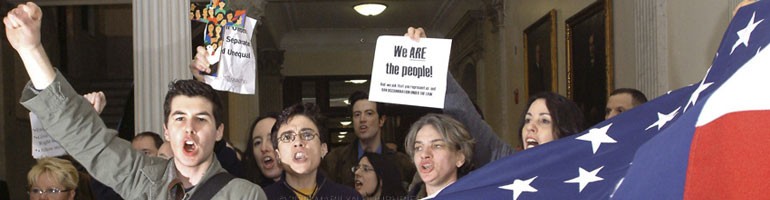
California Marriage Equality–“How Long?”

Martin Luther King, Jr. repeatedly asked, “How long?” How long until justice will come?

Just so our gay marriage allies in California like Molly McKay and Davina Kotulski, a couple for 12 years and activists for 10 years on this issue, continue their fight for the civil right of marriage.

King, an inveterate worker in the struggle for justice, persisted doggedly in the face of daunting odds. McKay and Kotulski and their allies in Marriage Equality USA now focus their energies on the California Supreme Court to seek justice. McKay and Kotulski were at the court for the historic argument on March 4, 2008 as were John Lewis and Stuart Gaffney, a couple for over 20 years.

Gaffney explained to interviewers that his interracial parents had to rely on the same court over 60 years ago to be allowed to marry. Now he and his partner Lewis hope the court will grant them the same civil right to marry that it granted to his parents.

The California legislature has voted for marriage equality twice. Twice the governor has vetoed the bill. Couples will not have to continue asking “How long” forever. The court must rule within 90 days. Not long.

Ellen, Murder, and Love in California

My point—and I have one—is that there is a connection between murder and love in the current highly charged culture war going on in California around the issue of marriage equality. Ellen almost makes the point.


Today the CA Supreme Court will hear a landmark case that seeks to bring marriage equality to millions of the state’s LGBT citizens. On February 12, 2008, 15 year-old Larry King of Oxnard, CA was murdered by a fellow eighth grader, Brandon, whom he asked to be his Valentine. My argument seems like a leap, but stay with me.


Ellen DeGeneres spoke up about Larry’s murder on her Leap Year Show. http://www.youtube.com/watch?v=QcMEL3_YsVI 


Millions of Ellen’s fans watched her thoughtful commentary on Larry’s murder, and over 137,000 have caught it on YouTube. Her arguments prompted over 840 viewers to write a comment on the YouTube site and 14 others to post video responses. Thousands then watch those videos. Well, you get it, the multiplier effect. When Ellen speaks, millions of fans listen and studio audiences go wild. A very good thing.


Ellen talks about the seeds of violence against gay people: punch lines in comedy monologues, gay jokes, verbal and physical abuse that can escalate into murder. I call it The Violence Escalator (see below). Very important information. Had she taken note of the current anti-gay marriage climate that is being whipped up in CA, folks might have made one more important connection. Climates of hate breed violence.


Today in California’s highest court, the Alliance Defense Fund and their ilk will argue that gay people are not worthy of marriage equality. For months, paid signature-gatherers funded by anti-marriage equality groups such as the Colorado-based Focus on the Family and the Virginia-based National Organization for Marriage have been all over California spreading the word of hate against gay people. In shopping centers, outside movie theatres, near coffee shops, the public is learning that they can stand up for prejudice and hate by signing the ballot petition for the November 2008 election to put marriage equality discrimination into the California constitution.


While I’m grateful to Ellen for what she did say, I wish that she had made that last connection: bigots are actively stirring up hate in California. In a climate of hate, innocent kids like Larry get murdered because they think that they are as free to love as everyone else. ~~~~~~~~~~~~~~~~~~~~~~~~~~~~~~~~~~~~~~~~~~~~~~~~~~~~~~~~~~~~~~~~

The Violence EscalatorViolence starts small but can escalate steadily and rapidly. Here are some of the steps: 

STEP 1 Jokes that disparage classes of people (i.e. women, lesbians, people of color)

STEP 2 Slurs that demean (i.e. “fag,” “bitch,” “gook”)

STEP 3 Threats and blackmail

STEP 4 Bullying that becomes physical

STEP 5 Psychological threats and bullying

STEP 6 Physical violence

STEP 7 Murder

Oscars, The L-Word, and LGBT Equality

Honolulu, HI–Being blessed by being in the middle of the Pacific, I could at an early hour channel surf between the glitz of the 80th Annual Oscars and The L-Word where Captain Tasha Williams, a decorated Iraq veteran, was getting drummed out of the military for homosexual conduct.

I kept hoping that in my ADD surfing behavior I wouldn’t miss the by-now-expected “gay moment” on the Oscars. Fortunately, I didn’t and the moment was a triumph for all of us struggling for LGBT civil rights.

In the midst of the Oscar’s garish sets, the wonders of technology allowed us to be transported to the desert in Iraq. There male and female military personnel, in the only costumes they get to wear, desert camouflague fatigues, presented the nominees for Best Short Documentary.

For me the irony sizzled. One nominee, Sari’s Mother, shows how the US has thrown the Iraqi medical system into disarray. Another, Freeheld, demonstrates that the freedom and liberty that some LGBT citizens fight for abroad are not theirs at home. And the Oscar went to Freeheld!

Freeheld tells the brave story of the final months of a New Jersey police officer’s fight with cancer and with the elected Board of Freeholders that governs Ocean County, NJ. Garden State Equality, especially the ever resourceful and impassioned Steve Goldstein, plays a crucial role in the poignant struggle of Detective Lieutenant Laurel Hester’s battle for her domestic partner Stacie Andree’s right to her pension benefits and financial security. Lieutenant Hester and Garden State Equality are the heroes of this wrenching saga.

I was stunned by the film’s power when I saw it last spring at the Boston Lesbian and Gay Film Festival and not surprised at all when it walked away with a Boston festival prize, a Sundance, and now an Oscar.

The L-Word’s fictional Captain Williams fighting a military court and the real Lieutenant Hester struggling for justice throw into sharp relief the discrimination LGBT people suffer and the bravery of those who will not accept it. Military and police officers put themselves in harm’s way for our safety. Injustice seems all the more ironic in the denial of their equality.

Know Thy Neighbor–On the Move in FL

Know Thy Neighbor (KTN) once again is bringing transparency to the ballot petition process–this time in Florida. What KTN did for the cause of equality in Massachusetts, it is now doing for all families in Florida. AND as a sidelight of their advocacy, some Floridians are getting a civics lesson.

Folks who claim that they never signed the petition to put a constitutional amendment banning gay marriage and even civil unions or domestic partnerships for heterosexuals on the ballot are learning, thanks to the KTN website, that their names were among the over 611,000 that counted.  Did unscrupulous signature-gatherers put their names on petitions?

Other Floridians who did sign the petition are learning that their signature is a matter of public record. They are astonished to see their names on the Know Thy Neighbor website. Thanks to a collaboration between Christ Church of Peace in Jacksonville, FL and KTN discrimination will not be able to hide behind a cloak of secrecy. Check out a Florida TV news report on the issues. 

Fairness for All Families offers Floridians strategies for fighting the discriminatory constitutional amendment. Know Thy Neighbor offers Floridians the opportunity to identify petition signers and begin conversations with neighbors, friends, and family members who may not know that their names are on the petition or who may not understand how hateful the constitutional amendment really is.