Category Archives: Massachusetts

Gay Marriage Boon to Massachusetts Economy

Kudos to Lisa van der pool who wrote in the Boston Business Journal on Feb. 28, 2008 about another plus for marriage equality in Massachusetts. Not surprisingly, she asserts that equal treatment of all people attracts talented workers. While there has been much anecdotal documentation of gay and lesbian couples coming to Massachusetts because of the protections that marriage offers, it’s noteworthy that a trade journal like BBJ has published this piece.

Note that the contention of an “exodus of families from Massachusetts because of the same-sex marriage law” by Kris Mineau, a marriage equality opponent, has not been supported in any published story.

Here is van der Pool’s story in its entirety (for those who are not subscribers to BBJ):

Gay marriage attracts out-of-state workforce
Boston Business Journal
– by Lisa van der Pool Journal staff

Massachusetts has a dubious reputation for losing talented workers to less pricey markets. But a trend that runs counter to the talent drain has emerged in the form of the state’s controversial same-sex marriage law.
Massachusetts native Jeffrey Webb loved the Los Angeles lifestyle. He had a great job as a law partner in the L.A. office of Gibson, Dunn & Crutcher LLP, and his life partner, Mark Schuster, was equally happy with his work as chief of general pediatrics and professor at UCLA. “We both had positions that were hard to replicate,” said Webb, 43.

 Even so, Webb and Schuster left the California sunshine in December and moved to Brookline with their twin sons. It wasn’t the promise of enduring a gloomy Massachusetts winter that beckoned them — it was the ability to live in Massachusetts as a legally married couple.

“That was something that was really important to us,” said Webb, who married Schuster in Massachusetts soon after the couple bought a vacation home in Truro in 2004. Webb has since joined the law firm McDermott, Will & Emery LLP as a partner in the trial department, and Schuster is now the chief of general pediatrics and vice chair for health policy research at Children’s Hospital Boston.

Massachusetts has a dubious reputation for losing talented workers to less pricey markets. But a trend that runs counter to the talent drain has emerged in the form of the state’s controversial same-sex marriage law, a powerful lure for same-sex couples who want to live in a place where they can get married, gain legal rights and have access to spousal health benefits. In fact, some observers see the influx of same-sex couples as a boon for the state’s economy.

“Since the marriage law passed, we see a lot more (gay) professionals moving into the Boston area,” said Henry Hoey, a board member of the Greater Boston Business Council, a chamber of commerce for gay professionals. The organization’s membership has increased 5 percent to 1,100 members since last year. “The effects of this law are starting to take hold.”

In 2003, the Massachusetts Supreme Judicial Court legalized same-sex marriage in a landmark ruling. The decision sparked an intense effort by same-sex marriage opponents to amend the state Constitution; but that effort died in the Legislature last year. Since 2004, 10,168 same-sex couples have said their “I-Do’s” in Massachusetts. And while same-sex nuptials have tapered off since the initial rush in 2004 when 6,121 couples tied the knot — last year 550 same-sex couples got married in the state — that likely reflects an expected leveling off since the law was passed, according to the Massachusetts Registry of Vital Records and Statistics.

The number of same-sex couples who have moved here since 2004 is not tracked by any organization. Martha Livingston, founder and CEO of Inclusive Recruitment LLC, a Boston-based staffing firm that places gay, lesbian, bisexual and transgender professionals in welcoming workplaces, has noticed an increase in gay and lesbian couples who have moved or are planning to move to the state.

“There’s a woman that I’m working with right now because she came to Massachusetts so her marriage would be recognized,” said Livingston.
Massachusetts’s population could use some fresh faces. From 2003 to 2005, the population fell to 6,429,137 from 6,438,510, according to estimates from the U.S. Census Bureau. While the population crept back up to 6,449,755 in 2007, according to census estimates, the population grew a mere 1.5 percent from 2000 to 2006.
Not everyone agrees that same-sex marriage will ultimately prove beneficial to the state’s economy.

“We view same-sex marriage as a radical social experiment and to promote it on behalf of the economy is akin to promoting casinos on behalf of the economy,” said Kris Mineau, president of the Massachusetts Family Institute in Woburn. “There’s anecdotal evidence that (there has been) an exodus of families from Massachusetts because of the same-sex marriage law. So there’s two sides to the story.”

It’s not only the legal rights afforded by the Massachusetts law, but also the relatively open-minded political climate of the region that is drawing more gay couples. Lisa Forest and her wife, Anne Marie Willer, both had good jobs and owned their own home in the Dallas area. But in 2006 the couple left Texas for Massachusetts and rented an apartment in Quincy. Forest works at Bridgewater State College, where she launched the college’s GLBTA Pride Center. Willer works as a librarian at the Massachusetts Institute of Technology. The couple married in 2006.

“It was a difficult move, but I found the political climate inhospitable,” Forest said of her time in Texas. She and Willer lived there for five years.

“There was a lot of psychological and physical energy that I was investing in just living my day-to-day life, because I had to defend myself against anti-gay sentiment and rhetoric. (But mainly) we were taking too large of financial and legal risks remaining there as strangers, legally,” Forest said.

The state’s same-sex marriage law could provide local businesses with a unique competitive edge, according to Carissa Cunningham, director of public affairs at Gay & Lesbian Advocates & Defenders in Boston.

“Massachusetts has a reputation for fairness both generally and in the specifics that it offers gay and lesbian couples, especially those with children who are concerned about raising their kids in a place that supports their family and protects their legal rights,” said Cunningham. “It makes the state competitive.”

While federal law does not recognize same-sex marriage, the benefits for gay couples who decide to marry on a state level still outweigh the drawbacks, according to Rick Kraft, an attorney who moved from Berkeley, Calif., to Massachusetts with his partner and their daughter in 2004. Benefits include partner health insurance, filing joint state tax returns and automatic inheritance if one spouse dies. One downside to marriage is that in the event of a split, alimony payments are not tax-deductable for same-sex couples, according to Kraft, who focuses his estate planning practice on the legal needs of lesbian, gay, bisexual and transgender people.

 “There are hundreds of automatic rights that come to couples when they’re married,” said Kraft, 46.

 Chris Ott, 37, and his partner, David Danaher, 40, decided to leave Wisconsin after the state passed a constitutional amendment to ban same-sex marriage. Ott moved to Cambridge after he sold his home in Madison. Danaher, a professor of Slavic languages at the University of Wisconsin, plans to remain until he finds a post in Boston.

The two haven’t married in Massachusetts yet.

“The passage of that amendment meant that there were going to continue to be legal and financial barriers and hardships which we didn’t want to contend with, especially later in life,” said Ott, communications director at the ACLU’s Boston office. “We wanted to live somewhere where these issues had already been settled.”
Lisa van der Pool can be reached at lvanderpool@bizjournals.com.

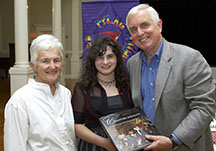
Cambridge Mayor Denise Simmons

Cambridge leads us, once again, into the light. Former Mayor Ken Reeves, a Black gay man, is succeeded in office by an “out” and fiery Black lesbian, Denise Simmons. Simmons has been a community activist for many years and played a key role in the same-sex marriage struggle in Massachusetts. On Nov. 18, 2003, the day the decision came down approving same-sex marriage, Simmons spoke at the Rally for Family and Equality at Old South Meeting House. On p.25 of Courting Equality, she is shown at the podium speaking with her little granddaughter, Tara Knight who is waving an American flag. There in the historic meeting house where patriots, including Samuel Adams, planned the Boston Tea Party, Simmons urged us on to protect the decision.

Simmons led the way to assure that her home town of Cambridge would be the first in Massachusetts to issue same-sex marriage license applications. On the evening of May 16, 2004, Cambridge opened the doors of City Hall and one minute after the stroke of midnight began taking marriage license applications. The city ushered in May 17th with enthusiasm and energy.

Ten thousand of us gathered inside and outside City Hall to rejoice in the latest extension of the meaning of liberty and justice for all. Simmons was at the center of it all.

Since May 17, 2004, Simmons has married many couples. She is sought after. We know that it is an honor to be married by someone who fought so hard for our victory.

A Native Hawaiian and an African American gay couple (who are also in Courting Equality on p. 157), told me about the care with which Denise helped them plan their wedding ceremony so that it would do justice to both of their cultural heritages, thus honoring their families as well at their ceremony.

Denise is a political figure with a deep commitment to her community and a keen attention to the people whom she represents literally and figuratively.

Liberty and justice are even more secure in Cambridge and the rest of the state with her in this leadership position!

Dads for Lesbian Daughters

from the Washington Blade Online

‘Family man’ tries to overturn Wis. gay marriage ban
Wants state to vote on marriage, civil unions as separate questions
(AP) | Dec 10, 3:10 PM

Few people took Bill McConkey seriously when he filed a lawsuit in July trying to overturn Wisconsin’s new ban on gay marriage and civil unions.

The relatively unknown University of Wisconsin-Oshkosh political science instructor was acting as his own lawyer and didn’t have the backing of the state’s major gay rights group.

But his challenge to the amendment — approved by 59 percent of voters last year — has picked up steam in recent weeks.

A Dane County judge ruled the lawsuit can go forward on grounds that McConkey was harmed as a voter by the wording of the question. McConkey claims the referendum illegally asked two questions in one — whether to ban gay marriage and whether to ban civil unions — and he wants the state to vote on each question.

So, who is this guy and why is he doing this? More

What’s great about this story is that we have another father coming out for his lesbian daughter’s civil rights. Bill McConkey joins San Diego mayor Jerry Sanders and probably millions of other fathers who support their children’s right to be legally connected and hopefully married to the person whom they love most in the world.

In suing for his civil right to be able to vote on gay marriage and civil unions as two separate ballot questions, McConkey, a political science professor at UW-Oshkosh presses for his legal rights as well as his daughter’s.

McConkey believes that the Wisconsin electorate would not have defeated civil unions in the 2006 election, but he concedes that gay marriage was probably doomed. He does believe, however, that gay marriage is a constitutional right. “I think ultimately I would say under the U.S. Constitution, the way it’s written, we cannot constitutionally deny the right of gay people to be married. Neither can the government order a church and say you have to marry gay people.”

Sanders like McConkey sees gay marriage as a civil right. He put a lot of his political capital on the line when he came all the way out for his daughter Lisa in pressing for gay marriage. As a California resident, Lisa Sanders, already had the right to enter into a domestic partnership that grants her all the rights and privileges of marriage. But as her dad poignantly noted what she does not have is the right to call herself married. On the day before he was kicking off his re-election campaign, September 19, 2007, he decided to, in his words, “lead with my heart.”

An emotional Mayor Sanders reversed his previous pledge to veto the San Diego City Council’s 5-3 vote to support gay marriage. He cited his acquaintances, staff, and most significantly his daughter, whose rights he could no longer deny. “In the end, I couldn’t look any of them in the face and tell them that their relationships, their very lives, were any less meaningful than the marriage I share with my wife, Rana,” said Sanders.

Ever since I began doing research for Courting Equality, I’ve been consistently impressed with the power of parents in support of their children’s civil rights. Their support is inspired by love and fired by a patriotic belief that all of their kids should have the same rights. In Courting Equality, one of Marilyn Humphries’ compelling photos shows a mother at a 2004 Massachusetts Constitutional Convention holding a sign that reads, “My Son Is Not a Second-Class Citizen.” Her sign says it all!

As parents speak out, politicians begin to listen more intently and then more politicians speak out. As both the electorate and the elected speak out the circle of equality is expanded.


Thank You, Mary Bonauto and GLAD

Thank You, Mary Bonauto and GLAD for Four Years of Equality!


Four years ago today at a press conference in Boston, on November 18, 2003, Mary Bonauto of Gay Lesbian Advocates&Defenders and the Goodridge plaintiffs taught me an important lesson in American democracy. Their visionary leadership and commitment made me see that marriage equality for LGBT families is an issue of democracy, a fundamental civil right. I had not seen it that way. Marriage was not on my political agenda. I’m a convert now married to Karen Kahn.

If my friend Marilyn Humphries, Bay Windows lead photographer, had not neglected to bring her largest photo flash card in to Boston that day, I might have missed the historic press conference. I got the job of fetching the flash card from Marilyn’s house and schlepping it to the Omni Parker Hotel. I stayed for the press conference. A year and a half later, Karen Kahn and I would begin writing a book featuring Marilyn’s photographs, Courting Equality: A Documentary History of America’s First Legal Same-Sex Marriages (Beacon Press, 2007).

Here’s part of what we said in the book about Nov. 18, 2003:

The Marriage Victory Press Conference

            On the walk over to the Omni Parker House Hotel, Bonauto and the plaintiffs had TV, radio, and print media trailing them and jockeying for the best shots and sound bites. The proud smiles on the faces of the plaintiffs told it all. Bonauto began the press conference. “Wow this is a very, very big day; it’s obviously a historic day . . . because finally all families in the Commonwealth of Massachusetts will have the opportunity to be equal families under the law.” With her voice ringing with conviction, Bonauto gave pause, “A court finally had the courage to say that this really is an issue about human equality and human dignity, and it’s time that the government treat these people fairly.”

            Continuing her effort to ensure that Massachusetts did not adopt civil unions, Bonauto clearly asserted her understanding of the ruling: “The issue in this case was whether or not it was constitutional to exclude same-sex couples from civil, legal, governmental marriages as well as all the protections that flow from that. That’s what the court ruled on today. It didn’t rule on a parallel system.” Bonauto then insisted that the plaintiffs be allowed to speak.

Protections of Marriage

            Julie Goodridge pointed out that the court affirmed what they had always felt: “We are a couple that is worthy of the protections of marriage, and that after 16 and a half years Hillary and I are finally going to be able to get married and protect our family.”

            Gary Chalmers, with Rich Linnell at his side, told the assembled press, “My partner of 15 years, finally after today, will be my official spouse come June. . . . We’ll finally be able to have health insurance and so many other legal benefits we need to keep our family safe and secure.”

Marriage as a Civil Right

            Poignantly, Wilson and Smith, both African American, noted the important civil rights dimension of the decision. Wilson smiled as he asserted, “It means I’m a full citizen with all the rights of a citizen.” Expanding on that point, Smith insisted, “The struggle for people to be treated equal is a long one, and it continues, and it gives me chills to think about that connection.”

            Towards the end of the press conference, the media questioned Bonauto again about why civil unions would not satisfy her clients. Her concise reply had probably been on her mind since the
Vermont legislature invented civil unions. “We think the word ‘marriage’ is one of the important protections because everybody knows what it means.” A TV reporter then asked her if she would get married and the usually very businesslike Bonauto looked down and then with a broad grin looked up, “You betcha!”


Goodridge anniversary commentary at Beacon Broadside

Take a look at Beacon Broadside, where Karen reflects on the fourth anniversary of the Goodridge decsion, and late summer adventures in Tennessee, Gerogia, and North Carolina (below, a photograph of Karen & Pat with Laurel Scherer and Virginia Balfour, in Asheville, North Carolina). 

 scherer-balfour-asheville-9-5-07.JPG

As we approach the fourth anniversary of Goodridge v. Department of Public Health, the Supreme Judicial Court decision that granted marriage equality to same-sex couples in Massachusetts, I find myself reflecting on the profound impact of this decision in my life. Before November 18, 2003, I had not considered marriage as anything more than an outdated, sexist institution. With the energy of the spurned outsider, I rejected marriage and all its trappings. I had no expectation that, in my life time, same-sex couples would be allowed to participate in this exclusively heterosexual ritual. Read more.

Marilyn Humphries featured in November Boston Spirit Magazine

If you are in the Boston area, pick up the November/December 2007 copy of Boston Spirit or go to the website to order your free subscription http://www.bostonspiritmagazine.com/   In this month’s issue, Pat Gozemba has a feature article on Marilyn Humphries’ two-plus decades photographing Boston’s LGBT community. Lots of pictures tracing LGBT activism since the early 1980s.

Gay Marriage, Lexington High, and Mass Resistance

“Gay.” “Lesbian.” “Same-sex marriage.” Words you’re not supposed to hear uttered in the Lexington Public Schools that is according to Brian Camenker and his pack at Mass Resistance. But Mass Resistance is not having its way.

PFLAG gave the first of over 240 copies of Courting Equality slated to go to Massachusetts Gay Straight Alliances (GSAs)to the GSA at Lexington High School.

Carla Yengo-Kahn, a sophomore, a Lexington High School accepted on behalf of her school’s GSA. In accepting the book Carla said, “It seems appropriate that we should get the first book going to GSAs. We are from Lexington, the birthplace of the American Revolution that was fought for the very principles of freedom central to our democracy, and appropriately, our educational system.”

She added that the Lexington curriculum includes, all people, all who should be part of “we the people.”

Mass Resistance continues to threaten open, safe, and welcoming school communities that respect all families by including them in the curriculum–especially when they include anything relating to the lesbian, gay, bisexual or transgender community. With the David Parker case centering around his and Brian Camenker’s objection to the use of King and King, Lexington has become another battleground.

Chuck Colbert writes this week on the PFLAG meeting and the presentation of Courting Equality and the challenges to democratic education.

PFLAG Donates Courting Equality to GSAs

_z3p4225web.jpg

At PFLAG’s Annual Meeting, President Stan Griffith presented a copy of Courting Equality to Carla Yengo-Kahn for the Lexington High School Gay Straight Alliance. Author Pat Gozemba (left) noted that the donation of a copy of the book would be made to each of the 241 GSAs in Massachusetts thanks to a generous donation to PFLAG by Chip McLaughlin and Keith Maynard.

McLaughlin and Maynard will also offer through PFLAG a copy of the book to each of the public high school libraries in schools that do not have GSAs. This means that shortly there will be a copy of the book in each public high school in MA.

“Greater Boston PFLAG beleieves that we can create safe and welcoming schools, communities, and places of work through education and dialogue. Distribution of Courting Equality is one way that we can educate and promote dialogue,” said Griffith.

Yengo-Kahn, a sophomore at Lexington High said, “We are from Lexington, the birthplace of the American Revolution that fought for the very principles of freedom central to our democracy, and appropriately, our educational system. A curriculum that includes all people, all who should be part of ‘we the people,’ is what we have in Lexington and we’re proud of it. I also want to mention that I am one of hundreds of citizens in our town who have been part of demonstrations to support diverse education in Lexington.”

Members of Mass Resistance, including Brian Camenker, who have been focused on dismantling GSAs attempted to crash the annual meeting but were asked to leave.

Courting Equality Rocks Ptown

Pat, Karen, & Denise from Austin 

On July 28, we celebrated marriage equality with Denise, a parent participant in Children of Lesbians and Gays Everywhere (COLAGE). Denise read Courting Equality in one afternoon, after her neighbor Orlando Del Valle lent her a copy. She was among many lesbian and gay families who gathered for Family Pride Week. Courting Equality drew a large crowd to the Provincetown Library, where state representatives Carl Sciortino and Sarah Peake, along with former Senator Cheryl Jacques, talked about the political struggle to win marriage equality.

Celebrating at the State House

Pat Gozemba & David Wilson

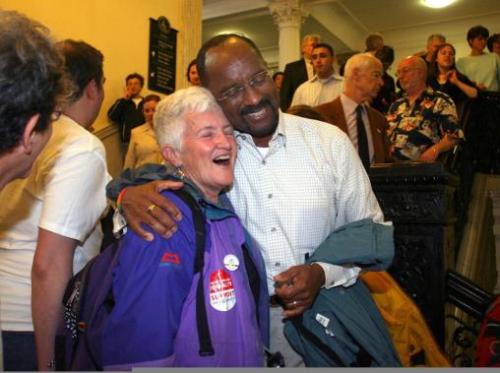
Pat Gozemba (left) of Salem was embraced by David Wilson, one of the original plaintiffs in the landmark same-sex marriage lawsuit. The pair celebrated after the vote outside the House chamber. (Boston Globe photo John Tlumacki)

June 14, 2007 will become a historic day in the annals of equality in this state and in this country. Gov. Deval Patrick said it right. “This is not just a great day for marriage equality–it’s a great day for equality.”

It was a thrill to celebrate with Dave Wilson and with the thousands of marriage equality supporters who came to the State House for this nerve-wracking but historic day.

All of us in the LGBT community and our allies who have spent countless hours and days working on this issue feel grateful to the 151 legislators (75% +1) who voted for equality. New profiles in courage emerged!

Check our blog later for more photos by Marilyn Humphries.