Arkansas: Still A Civil Rights Frontier

Pat Gozemba and Karen Kahn have been invited to share the message of marriage equality at the University of Arkansas in Fayetteville. Their talk is entitled “Marriage Equality: A 21st Century Civil Rights Struggle.” At the flagship campus of the university, they are being sponsored by the School of Law and the J. William Fulbright College of Arts and Sciences.

The authors see the appropriateness of bringing their struggle to Arkansas the scene of such heroic struggle 50 years ago at Little Rock High School.

In 2004 Arkansas voters amended their constitution to prohibit marriage equality by a 3 to 1 margin. Now the Little Rock-based Family Council that spear-headed the constitutional amendment is at it again. They are working to get on the ballot for 2008 an initiative that would ban unmarried couples from adopting or fostering children. (That’s gay and lesbians–especially.)

The first draft of the Family Council initiative was rejected by the state attorney general  as too partisan for inclusion on a ballot. According to Laura Kellams of the Arkansas Democrat-Gazette, the Family Council wanted to include on the ballot a statement that “referred to marriage as the ideal child-rearing environment and to ‘cohabiting’ households as more prone to instability, poverty, and other societal ills.”

Jerry Cox president of the Family Council wanted that language on the ballot but will do what he needs to do to get the attorney general to approve the initiative–including toning down the initial language.

This current initiative would not be a constitutional amendment but it would become state law if passed by the voters. It would take a two-thirds majority of the legislature to remove the law.

Currently lesbians and gays are tacitly excluded from fostering or adopting children. Opponents to equality are looking to lock in that inequality.

The University of Arkansas has sexual orientation as a protected class in its Affirmative Action program. Their are no benefits for LGBT people and their significant others. Arkansas is still on the civil rights frontier. More
PFLAG Donates Courting Equality to GSAs

_z3p4225web.jpg

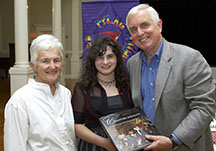
At PFLAG’s Annual Meeting, President Stan Griffith presented a copy of Courting Equality to Carla Yengo-Kahn for the Lexington High School Gay Straight Alliance. Author Pat Gozemba (left) noted that the donation of a copy of the book would be made to each of the 241 GSAs in Massachusetts thanks to a generous donation to PFLAG by Chip McLaughlin and Keith Maynard.

McLaughlin and Maynard will also offer through PFLAG a copy of the book to each of the public high school libraries in schools that do not have GSAs. This means that shortly there will be a copy of the book in each public high school in MA.

“Greater Boston PFLAG beleieves that we can create safe and welcoming schools, communities, and places of work through education and dialogue. Distribution of Courting Equality is one way that we can educate and promote dialogue,” said Griffith.

Yengo-Kahn, a sophomore at Lexington High said, “We are from Lexington, the birthplace of the American Revolution that fought for the very principles of freedom central to our democracy, and appropriately, our educational system. A curriculum that includes all people, all who should be part of ‘we the people,’ is what we have in Lexington and we’re proud of it. I also want to mention that I am one of hundreds of citizens in our town who have been part of demonstrations to support diverse education in Lexington.”

Members of Mass Resistance, including Brian Camenker, who have been focused on dismantling GSAs attempted to crash the annual meeting but were asked to leave.

Gay Straight Alliances to Receive Courting Equality

Greater Boston PFLAG (Parents, Friends, and Families of Lesbians and Gays), at their annual meeting on Sept. 24th at 7 pm, will donate Courting Equality: A Documentary History of America’s First legal Same-Sex Marriages to all Gay Straight Alliances (GSAs) in Massachusetts public schools and offer it to all public high school libraries. Lexington High School GSA will be present to receive the first copy.

PFLAG’s annual meeting will be at the Congregational Church of Needham, 1154 Great Plain Ave., Needham, MA 02492.

Greater Boston PFLAG worked tirelessly to assure marriage equality in MA. The organization believes that sharing the history of this important civil rights victory with high school students will encourage diversity and tolerance. Courting Equality shows how all people can fight for their rights in a democratic society.

The Lexington High School GSA was asked to accept the first book, because Lexington schools have been challenged over their commitment to diverse education. Article 8 Alliance and MassResistance, led by Brian Camenker, have taken the town to court for including books that recognize love between two people of the same gender in its curriculum.

Gay Lesbian Advocates and defenders (GLAD) will be filing a Friend of the Court brief in the First Circuit Court of Appeals on behalf of Greater Boston PFLAG in support of Lexington town officials who have stood firmly in support of diversity and safe welcoming schools for children of all families.

Chip McLaughlin and Keith Maynard of Cambridge, who are pictured on the cover of Courting Equality, contributed funds to Greater Boston PFLAG to make the donation to each GSA and high school library possible.

The PFLAG annual meeting is open to the public. For more information and the agenda go to the PFLAG site.

Straight Allies in Asheville

When progressive activists Frank and Margaret Adams learned that we were going to present on marriage equality at Highlander’s 75th Anniversary outside of Knoxville, TN, they insisted that we come to their home town of Asheville, NC and do a reading and presentation. Frank, a former director of Highlander, and Margaret, both in their 70’s know what struggles for equality look like and they have always been ready to become involved. Agitating and organizing against economic, racial, environmental, you-name-it discrimination  are part of their daily lives–have been for years. Now they are allies for marriage equality. 

In Frank Adams’ 1975 book Unearthing Seeds of Fire (now in its fifth printing), he shares compelling stories of the work of allies in struggles for justice–the motivating force of Highlander. Now he and Margaret are unearthing other seeds of fire in this struggle for marriage equality. They are motivated by a deep appreciation of  what Frank calls “freedom’s joy.”

What many LGBT people in the marriage equality movement do not understand is how many allies we have in the straight community around the country. The compelling factor for most of these allies is knowing someone in the LGBT community.  Frank and Margaret know many LGBT people, but others sometimes know only their child or their co-worker or their friend. In Courting Equality, a woman holds a sign that reads, “My Son Is Not a Second-Class Citizen.” Few legislators in Massachusetts argued with that. That mother’s activism and the activism of others in Parents, Friends and Families of Lesbians and Gays (PFLAG) held great sway with our legislators.

The important step for those of us striving for gay marriage equality is to come out. Very old concept. Very effective strategy. We have many straight allies in Asheville, NC,and we have many committed LGBT people who are building alliances. On September 5th over 60 people came out to Malaprop’s Books to learn about Courting Equality. At least six ministers were in the audience, three of them straight. These allies are critical to our achieving full equality.

Ersatz Gay Marriage: “Confusing Twilight Zone”

 The majority of Democratic presidential candidates and even some folks who consider themselves fair-minded pretend that supporting civil unions–the separate but equal remedy for gay family relationships– gives us our civil rights. Across the country, however, LGBT experience in domestic partnerships, reciprocal beneficiary relationships, and yes, civil unions, has demonstrated  that it just isn’t so.

CA is stepping into the foreground, again, to argue in court that only marriage is equal. Ersatz gay marriage just does not cut it.

Courts, politicos, opinion leaders, and those committed to true equality should stop ignoring the success of gay marriage in MA for the past three years.

MA is the only state in which committed LGBT couples have clear rights and responsibilities because they are married. Everyone knows what marriage is. Only attorneys state by state really know what the distinctions are between a civil union in NJ or CT or VT and soon in NH. Or a domestic partnership is in CA. Or what a reciprocal beneficiary protection is in Hawaii.

When the ACLU, Equality California, the National Center for Lesbian Rights, and Lambda Legal filed briefs last week in a coordinated case in CA seeking marriage rights for gay people, the challenge for full equality had its basis in the inequalities of domestic partnerships and it could have an anchor in reality on the East Coast of the country. MA has proved that marriage equality works.

The Advocate of Aug. 23 reported that Lambda Legal senior counsel Jennifer Pizer said in a statement that anything less than marriage is a “confusing twilight zone” for gay and lesbian couples. “We know this because we answer the distress calls every day—calls that began with the first statewide domestic partner bill in 1999 and haven’t slowed as the law broadened over the years. To the contrary, the distress calls have increased as more couples register, hoping to shield their families, and encounter inconsistent, incomplete protections. We’ve welcomed the supreme court’s invitation to explain how far domestic partnerships fall short of full marriage.”

Poll in NJ Shows Huge support for Gay Marriage

Is it a surprise to anyone that the NJ  poll conducted between Aug. 8-10 shows twice as much support for gay marriage as there is opposition? 63% favor same-sex marriage.  And just to quell the timid hearts of legislators, 72% of those polled (that’s 9% more than are in favor of marriages over civil unions) also said that taking a position in favor of gay marriage would not jeopardize the election of any legislators in the next election. So why would any legislators hold back? More 

Courting Equality Rocks Ptown

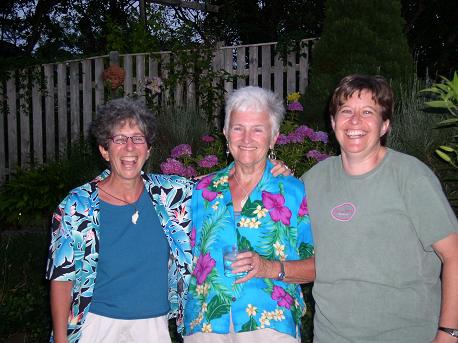
Pat, Karen, & Denise from Austin 

On July 28, we celebrated marriage equality with Denise, a parent participant in Children of Lesbians and Gays Everywhere (COLAGE). Denise read Courting Equality in one afternoon, after her neighbor Orlando Del Valle lent her a copy. She was among many lesbian and gay families who gathered for Family Pride Week. Courting Equality drew a large crowd to the Provincetown Library, where state representatives Carl Sciortino and Sarah Peake, along with former Senator Cheryl Jacques, talked about the political struggle to win marriage equality.

Seeking Gay Marriage Equality in Vermont

Beth Robinson c0-counsel in the landmark Baker case that essentially won equality in the Vermont courts in 1999 but lost it to a new invention called “civil unions” in the Vermont legislature in 2000 continues to push for full marriage equality. In the August 12th issue of the Rutland Herald, she sensibly defends the Vermont legislature’s creation of a “primarily citizen panel” that will take up the real inequities of the rights afforded to same-sex couples with civil unions contrasted with full rights afforded to heterosexual couples with marriage. 

While some Vermonters who do not support marriage equality are saying that this panel, that will report back in 2008, is divisive because other priorites for families are more pressing, Robinson argues pointedly that all families of Vermonters need to be considered. “For many of us, what’s divisive is laws that put families formed by same-sex couples in a separate category from families formed by heterosexual couples. The commission process won’t create division; it will repond to fissures that exist in our laws to help heal the division.”

Vermont House Speaker Gaye Symington and Senate President Pro Tem Peter Shumlin should be applauded for creating a panel to consider, as Robinson says, “whether there’s a good reason to keep separate legal structures for same-sex couples and heterosexual couples in Vermont.”

Robinson, Susan Murray, and Mary Bonauto were visionary in forging the Vermont case that led to our nation’s first shred of same-sex relationship equality, civil unions in 2000. Bonauto’s 2003 marriage equality victory in the Massachusetts courts set a new standard of equality for same-sex couples. Robinson points out that 2007 is a different era from 2000. For one, Massachusetts over the past 3 years has demonstrated that full marriage equality for all citizens does not breed any social discord.

Robinson led the way for same-sex couples in Vermont in the courts and as the chairwoman of Vermont Freedom to Marry she is sensibly leading the way in democratic discourse among citizens. The pace of progress is measured and Robinson and others have their eyes on the prize of full marriage equality. She knows it works in Massachusetts. Her visionary colleague Bonauto has shown the way in the state just south of Vermont.

But What About in Sickness?

The story below from Indiana illustrates one of the disastrous dilemmas that committed same-sex couples face in not being able to have a legal relationship with each other. In Massachusetts, some of the most convincing arguments put forth by our legislators as they debated whether to support our Supreme Judicial Court’s decision allowing same-sex marriage were those focused around times of a medical crisis. Legislators and those of us advocating for same-sex marriage realized that medical crises for loved ones are often the most stressful moments of our lives.

After same-sex couples began marrying in Massachusetts on May 17, 2004, more reassuring stories about emergency rooms gave us insights into the power of marriage.In Courting Equality, Dawn Paul and George Smart share reassuring stories about being able to be with their spouses immediately upon announcing that they were married.

Patrick Atkins and Brett Conrad were not so lucky as 365Gay.com recounts:

 Indianapolis, Indiana. For a quarter century Patrick Atkins and Brett Conrad shared their lives including a home and bank accounts but when Atkins fell near fatally ill Conrad discovered he had no rights in determining the care or who would deliver it to his ailing partner.

In 2005 Atkins collapsed while on a business trip to Atlanta. He had a ruptured aneurysm and later suffered a stroke while hospitalized.

When Conrad arrived in Atlanta Atkins’ family directed the hospital to refuse him access to the ailing 47-year old, the Indianapolis Star reports. He was allowed by sympathetic hospital staff to sneak in after hours and after Atkins parents had left.

When Atkins was moved to a nursing home Conrad again was forced to sneak in to see the man with whom he had spend more than half his life. 

Later that year Conrad filed for guardianship of Atkins. But the now severely disabled man’s parents quickly moved their son to their home and have refused to allow Conrad access to him. More

Debating gay marriage

Cynthia Laird reports in the Bay Area Reporter (8/2/07) that the East Bay LGBT Democratic Club in Berkeley had a lively discussion about the pros & cons of gay marriage.

Former club president Tom Broughan argued that the marriage fight is likely to lead to even more states passing constitutional amendments that ban marriage–and often legal recognition of any sort for gay couples. According to Laird,

Brougham clarified that much of his concern with the current situation arises from the fact that 18 states ban same-sex marriage and civil unions and domestic partnerships in their constitutions, while eight states ban same-sex marriage. Twenty states have laws against same-sex marriage. Two states – New Mexico and Rhode Island – leave the matter undefined, and one state – Massachusetts – allows same-sex marriage.

California’s domestic partner registry includes all of the state rights granted to married couples. The state’s marriage battle is currently being waged in the state Supreme Court and in the legislature, where a gender-neutral marriage bill is pending in the Senate.

Brougham argued that the community has lost in every ballot fight except one (Arizona), “and we still have anti-marriage laws on the books.”

He’s also afraid that such efforts “will take down domestic partnerships.”

Brougham may be right that it has been difficult to fight anti-gay-marriage amendments, but we shouldn’t be fooled into thinking that civil unions offer real equality. As we all know, civil unions and domestic partnerships are politically palatable because they maintain the status quo view that gay people aren’t really worthy of marriage. When we push the envelope, we force heterosexuals to examine why this is the case. That forced introspection dramatically changed the landscape for lgbt families in Massachusetts. Real equality is worth the fight. Besides, pandora’s box has been opened, and we’re not going away.