Category Archives: civil rights

Goodridge anniversary commentary at Beacon Broadside

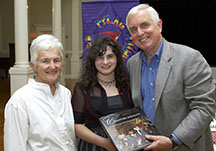
Take a look at Beacon Broadside, where Karen reflects on the fourth anniversary of the Goodridge decsion, and late summer adventures in Tennessee, Gerogia, and North Carolina (below, a photograph of Karen & Pat with Laurel Scherer and Virginia Balfour, in Asheville, North Carolina). 

 scherer-balfour-asheville-9-5-07.JPG

As we approach the fourth anniversary of Goodridge v. Department of Public Health, the Supreme Judicial Court decision that granted marriage equality to same-sex couples in Massachusetts, I find myself reflecting on the profound impact of this decision in my life. Before November 18, 2003, I had not considered marriage as anything more than an outdated, sexist institution. With the energy of the spurned outsider, I rejected marriage and all its trappings. I had no expectation that, in my life time, same-sex couples would be allowed to participate in this exclusively heterosexual ritual. Read more.

Gay Marriage for Vermont?

On October 11 and 12, Karen Kahn and I got to talk with Vermont folks about the success of marriage equality in Massachusetts. The topic is particularly relevant to Vermonters who are now considering gay marriage as a next step in the movement toward equality for LGBT people.

 On Oct. 11th at the University of Vermont, we got to meet David Moats, author of Civil Wars, a wonderful book on the 1999-2000 political struggle in Vermont following the Vermont court’s 1999 decision to give us relationship equality. Moats does a masterful job of taking us inside the Montpelier State House and following in particular the brave work of openly gay Rep. Bill Lippert.

At Burlington College on the 12th, we got to speak on a panel with Lippert. Amazing guy. Thoughtful, big-hearted, and the best spokesperson our community could ever imagine having.

Meeting Moats and Lippert qualifies as the highlight of our 5 months of touring with Courting Equality. Both men are clear thinkers and eloquent.

Vermonters are a fascinating and fiercely independent people and as they now take up the issue of marriage equality–again–the voices of Moats and Lippert are two that I want to be listening to. Check out Moats’ editorial.

“Dear Abby” Supports Gay Marriage

PFLAG will give its first Straight for Equality award to the woman we know as “Dear Abby.” In an October 5th nationally syndicated column, she came out in support of gay marriage.

It’s sort of like getting approval from your parents, your favorite aunt, your favorite teacher, your thoughful spiritual counselor, and your neighborhood association all at once. The cultural power of “Dear Abby’s” approval is enormous. Even the Associated Press has taken notice of the significance of Abby’s blessing.

While those of us in the struggle for marriage equality often get discouraged by the moneyed fire-power of social conservatives, we are getting incremental support from people who believe in constitutional rights based on liberty and freedom. Abby is one such person–one of the many who the Pew Center keeps telling us is slowly making the turn towards equality for all. She sees us as part of  the “we” in “we the people.”

PFLAG’s national acknowledgement of  “Dear Abby’s” leadership is important. PFLAG is at the cutting edge of hastening approval for gay marriage. In Massachusetts, Greater Boston PFLAG on Sept. 24th launched a project to give a copy of Courting Equality to every high school in Massachusetts. Within the month every high schooler will have an opportunity to see real photos of gay families and to imagine a happy family life for themselves. Even the LGBT kids!

Having heard of the the Greater Boston PFLAG project of getting the book out to every high school, the San Jose/Peninsula, California chapter of PFLAG invited the authors of Courting Equality to come out and speak at their chapter meeting on November 14th.

Straight allies for equality, such as “Dear Abby” and the many Parents, Family, Friends of Lesbians and Gays are creating a sea change of public opinion. We need to keep spreading the word and welcoming their support.

Arkansas: Still A Civil Rights Frontier

Pat Gozemba and Karen Kahn have been invited to share the message of marriage equality at the University of Arkansas in Fayetteville. Their talk is entitled “Marriage Equality: A 21st Century Civil Rights Struggle.” At the flagship campus of the university, they are being sponsored by the School of Law and the J. William Fulbright College of Arts and Sciences.

The authors see the appropriateness of bringing their struggle to Arkansas the scene of such heroic struggle 50 years ago at Little Rock High School.

In 2004 Arkansas voters amended their constitution to prohibit marriage equality by a 3 to 1 margin. Now the Little Rock-based Family Council that spear-headed the constitutional amendment is at it again. They are working to get on the ballot for 2008 an initiative that would ban unmarried couples from adopting or fostering children. (That’s gay and lesbians–especially.)

The first draft of the Family Council initiative was rejected by the state attorney general  as too partisan for inclusion on a ballot. According to Laura Kellams of the Arkansas Democrat-Gazette, the Family Council wanted to include on the ballot a statement that “referred to marriage as the ideal child-rearing environment and to ‘cohabiting’ households as more prone to instability, poverty, and other societal ills.”

Jerry Cox president of the Family Council wanted that language on the ballot but will do what he needs to do to get the attorney general to approve the initiative–including toning down the initial language.

This current initiative would not be a constitutional amendment but it would become state law if passed by the voters. It would take a two-thirds majority of the legislature to remove the law.

Currently lesbians and gays are tacitly excluded from fostering or adopting children. Opponents to equality are looking to lock in that inequality.

The University of Arkansas has sexual orientation as a protected class in its Affirmative Action program. Their are no benefits for LGBT people and their significant others. Arkansas is still on the civil rights frontier. More

PFLAG Donates Courting Equality to GSAs

_z3p4225web.jpg

At PFLAG’s Annual Meeting, President Stan Griffith presented a copy of Courting Equality to Carla Yengo-Kahn for the Lexington High School Gay Straight Alliance. Author Pat Gozemba (left) noted that the donation of a copy of the book would be made to each of the 241 GSAs in Massachusetts thanks to a generous donation to PFLAG by Chip McLaughlin and Keith Maynard.

McLaughlin and Maynard will also offer through PFLAG a copy of the book to each of the public high school libraries in schools that do not have GSAs. This means that shortly there will be a copy of the book in each public high school in MA.

“Greater Boston PFLAG beleieves that we can create safe and welcoming schools, communities, and places of work through education and dialogue. Distribution of Courting Equality is one way that we can educate and promote dialogue,” said Griffith.

Yengo-Kahn, a sophomore at Lexington High said, “We are from Lexington, the birthplace of the American Revolution that fought for the very principles of freedom central to our democracy, and appropriately, our educational system. A curriculum that includes all people, all who should be part of ‘we the people,’ is what we have in Lexington and we’re proud of it. I also want to mention that I am one of hundreds of citizens in our town who have been part of demonstrations to support diverse education in Lexington.”

Members of Mass Resistance, including Brian Camenker, who have been focused on dismantling GSAs attempted to crash the annual meeting but were asked to leave.

Debating gay marriage

Cynthia Laird reports in the Bay Area Reporter (8/2/07) that the East Bay LGBT Democratic Club in Berkeley had a lively discussion about the pros & cons of gay marriage.

Former club president Tom Broughan argued that the marriage fight is likely to lead to even more states passing constitutional amendments that ban marriage–and often legal recognition of any sort for gay couples. According to Laird,

Brougham clarified that much of his concern with the current situation arises from the fact that 18 states ban same-sex marriage and civil unions and domestic partnerships in their constitutions, while eight states ban same-sex marriage. Twenty states have laws against same-sex marriage. Two states – New Mexico and Rhode Island – leave the matter undefined, and one state – Massachusetts – allows same-sex marriage.

California’s domestic partner registry includes all of the state rights granted to married couples. The state’s marriage battle is currently being waged in the state Supreme Court and in the legislature, where a gender-neutral marriage bill is pending in the Senate.

Brougham argued that the community has lost in every ballot fight except one (Arizona), “and we still have anti-marriage laws on the books.”

He’s also afraid that such efforts “will take down domestic partnerships.”

Brougham may be right that it has been difficult to fight anti-gay-marriage amendments, but we shouldn’t be fooled into thinking that civil unions offer real equality. As we all know, civil unions and domestic partnerships are politically palatable because they maintain the status quo view that gay people aren’t really worthy of marriage. When we push the envelope, we force heterosexuals to examine why this is the case. That forced introspection dramatically changed the landscape for lgbt families in Massachusetts. Real equality is worth the fight. Besides, pandora’s box has been opened, and we’re not going away.

NM Should Lead the Way in MA

Marriage: Let New Mexico work it outBoston Globe, Editorial, August 2, 2007

Since the Massachusetts Department of Public Health isn’t a family court in Albuquerque, it shouldn’t have to interpret New Mexico’s marriage rules. Yet under a 1913 Massachusetts law, out-of-state couples cannot marry here if their union would be illegal at home. So DPH, which includes the Registry of Vital Records and Statistics, had to pass judgment on whether New Mexico forbids same-sex marriage. It does not, the department concluded last week. While we hope New Mexico will uphold equal rights for all, that state can set its own policies. The Massachusetts law is an ugly throwback to a time when interracial marriages were allowed here but banned in much of the rest of the country. It should be repealed.

Amen. The 1913 law should have been repealed years ago. It will be.

The real challenge in today’s Globe editorial is offered to marriage equality activists in New Mexico. They now have a great opportunity to show the way in our country’s march toward full citizenship for LGBT people.

Massachusetts’s firm commitment to equality through all levels of state government now makes it possible for LGBT people in a few other states to benefit from our state’s leadership. There is a great opportunity for people from NM to seek justice in MA and then return home to begin the transformation process of making gay marriage a reality in more states.

NM Gov. Bill Richardson is committed to pushing for domestic partnerships with all the rights and benefits of marriage. Let’s hope that he can be pushed beyond this separate-but-equal solution.

 The first brave steps, however, must be taken by LGBT citizens of NM who come here to marry. I’m calling my friends in NM and inviting them here for a beautiful Massachusetts summer wedding. Let freedom ring!

R.I. Fails to Advance Marriage Equality

This legislative session, R.I. failed to emerge as one of the New England states leading the nation to marriage equality. In the final hours, the governor vetoed domestic partnership benefits for state employees. According to Jenn Steinfeld, Executive Director of Marriage Equality Rhode Island (MERI), the legislature also failed to move ahead several other bills advancing LGBT family equality. EDGE Boston reports:

The Rhode Island General Assembly failed to show their support for Rhode Island same-sex couples and their families by allowing the majority of the MERI platform of domestic partner protections to die without a vote.“We are particularly disappointed in the lack of leadership demonstrated by our elected officials in a year where every other New England state has taken great strides to expand the protections available to same-sex couples and their families,” emphasized Steinfeld.

MERI proposed seven bills proposing protections for same sex couples, in addition to bill S-619. These bills referred to testimony rights, family medical leave, funeral planning, nursing home visitation, ability to sue in a case of wrongful death, and two same-sex marriage bills.

Read more of Tanya Rogers story at EDGE Boston.

Lastest on California marriage case

EdgeBoston reports:

The California Supreme Court has issued an unusual request in its hearing of a lawsuit for marriage equality: each side has been asked to answer three straightforward questions.According to a story posted on 356Gay.com yesterday, California’s highest court posed the questions because the justices felt that the briefs filed by both sides earlier this year had failed to address several basic points on the matter.
The first answer the court required from both sides was a specific and detailed explanation of how California’s existing domestic partnership law–one of the most comprehensive in the country–and legal marriage differ from one another in terms of legal rights for families.

Secondly, the court required lawyers from both sides to offer their interpretations of what the California state constitution’s provisions might be for marriage rights. Whether the constitution implicitly extends legal equality for gay and lesbian couples seeking marriage, or implicitly limits marriage to heterosexual couples, the existing constitutional provisions would have to be followed until and unless an amendment changed the state’s constitutional provisions for marriage.

From the second question’s ramifications, the court also sketched out a third question: “Do the terms ’marriage’ or ’marry’ themselves have constitutional significance under the California constitution?”

To read more, go to EdgeBoston.

New York Assembly votes yes on equal marriage

With the leadership of Democratic Governor Eliot Sptizer and Assemblyman Daniel O’Donnell (Rosie’s brother), the New York Assembly approved legislation guaranteeing marriage equality for gay and lesbian couples on June 19. Though not expected to pass the Senate, the historic 85-61 vote, makes it clear that New York is following in the steps of other Northeast states in finally legally recognizing gay relationships. More.